SEMINAR 2026
Sensing and generating multi-axial mechanical forces on biomolecules using molecular devices built from DNA
| Speaker | A/Prof Rizal F. Hariadi, Department of Physics and Biodesign Institute, Arizona State University, USA |
| Date/Time | Monday, 12 Oct, 2pm |
| Location | S11-02-07 Conference Room |
| Host | A/Prof Wang Zhisong |
Abstract
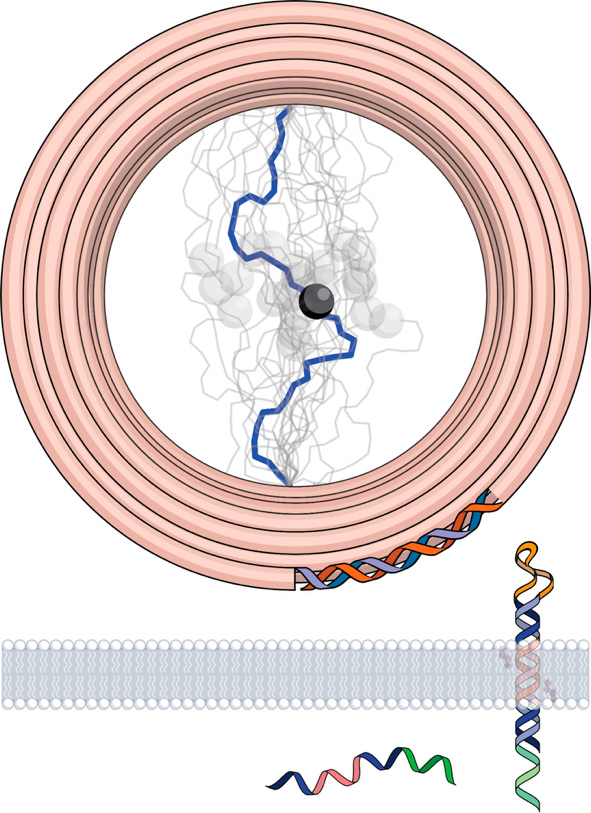
DNA nanotechnology enables the construction of molecular devices for diverse applications, including in Biophysics. By leveraging DNA’s exquisite positional control, along with its predictable thermodynamics and kinetics, researchers can engineer molecular machines that execute a range of tasks. In this talk, I will present two recent DNA-based devices from my lab: a DNA origami platform for multi-axial mechanical manipulation of biomolecules (https://doi.org/10.1101/2025.06.10.658941), and an amphiphilic double-stranded DNA sensor for non-destructive sensing of intracellular biomarkers (https://doi.org/10.1101/2025.10.29.685379). In the first part of my talk, I will present results on the Holliday junction, a classic model system in biophysics, under multi-axial tension using the Multi-Axial Entropic Spring Tweezer along Rigid Origami (MAESTRO). This molecular tool uses the entropic elasticity of single-stranded DNA as a calibrated spring. With it, we find that Holliday junction dynamics are non-ergodic: a single junction does not explore its conformational landscape the way the ensemble average implies. Neither bulk measurements nor single-axis force spectroscopy can see this. In the second half of the talk, I will show HALOS (Hybridization Across Lipid for Oligonucleotide Sensing), which addresses a physical problem: relaying information across a four-nanometer hydrophobic barrier without opening a pore. Cholesterol anchors drive insertion into the bilayer, strand displacement supplies the switching, and the resulting conformational change is read out optically. The talk concludes with a discussion of potential applications: high-throughput single-molecule biophysics of integrins, the mechanical sensors of cells; cryogenic electron microscopy (cryo-EM) of integrins held under tension; and live-cell isolation for cell therapy.
Biography
Rizal Hariadi was born in Surabaya, Indonesia. He joined the Department of Physics and the Biodesign Institute at Arizona State University in 2016, where he established BIOmolecular Nanosystems with Increasing Complexity and Size (BIONICS) Laboratory. His passion for science began with an enlightening experience in the Indonesian Physics Olympiad team, leading to his undergraduate degrees at Washington State University under the tutelage of Tom Dickinson, followed by a Ph.D. at California Institute of Technology. There, Rizal focused on the non-equilibrium dynamics of DNA nanotubes and the hydrodynamics of bursting bubbles under the guidance of Erik Winfree and Bernard Yurke. He subsequently completed postdoctoral research in single-molecule biophysics at both the University of Michigan with Sivaraj Shivaramakrishnan and the Wyss Institute at Harvard University with Peng Yin. Currently, his interdisciplinary team at Arizona State University develops precision tools from the molecular to centimeter-scale for bottom-up reconstruction of mechanical systems involved in disease pathogenesis. Along the way, the lab immerses itself in the mystery of the origin of life and develops frugal technologies in the global health context for resource-poor settings. Rizal is the recipient of an Arizona Biomedical Research Commission New Investigator Award, an NSF CAREER Award, and an NIH Director’s New Innovator Award.