JWST Views the Wreckage of Planetary Systems Around White Dwarfs
Speaker
A/Prof JJ Hermes, Boston University, USA
Date/Time
Wednesday, 7 Oct, 3pm
Location
S11-02-07 Conference Room
Host
Asst/Prof Marc Hon
Abstract
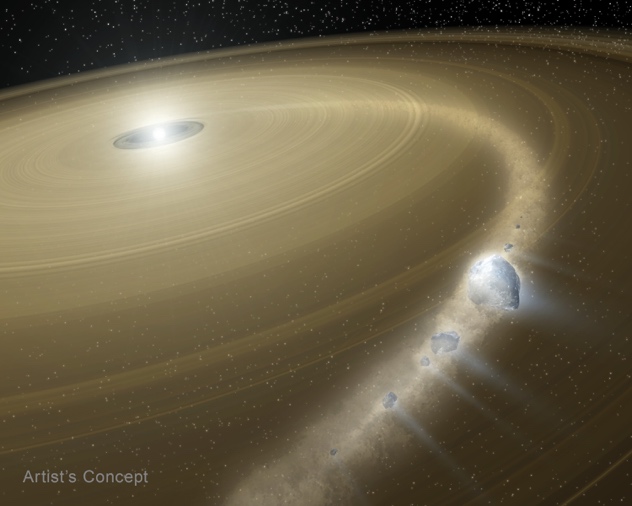
Planetary systems do not simply disappear when their stars die: planets and asteroids can survive on wide orbits and later be scattered inward toward the remnant white dwarf, generating compact debris disks. I will present James Webb Space Telescope (JWST) observations of two systems that let us study this wreckage in complementary ways. In G29−38, stellar pulsations act as a rapidly varying illumination source, revealing how an unresolved debris disk responds thermally to the star and providing new constraints on the geometry of the star–disk system. In ZTFJ0328−1219, years of photometric monitoring and Hubble Space Telescope ultraviolet spectroscopy reveal a transiting debris system evolving on rapid timescales, before JWST caught it in an unusually deep state of transit activity. Together, these observations connect the dynamics, grain sizes, mineralogy, and eventual accretion of planetary debris, showing that planetary systems can remain remarkably active long after stellar death.
Credit: T. Pyle (Caltech, NASA JPL)
Biography
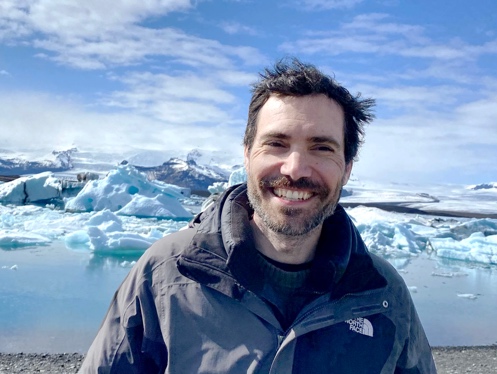
JJ Hermes is an Associate Professor of Astronomy at Boston University. His primary research interests converge on white dwarf stars, the final evolutionary state for more than 97 percent of all stars in our Galaxy. He uses pulsating and binary white dwarfs to determine fundamental parameters of these burnt-out stars, and studies their remnant planetary systems. He received a PhD from the University of Texas at Austin and held postdoctoral positions at the University of Warwick as well as a Hubble Fellowship at the University of North Carolina at Chapel Hill.