SEMINAR 2026
Probing fundamental physics with Extreme Mass-Ratio Inspirals: waveform systematics from post-adiabatic corrections
| Speaker | Dr Susanna Barsanti, University College Dublin, Ireland |
| Date/Time | Wednesday, 22Jul, 3pm |
| Location | S11-02-07 Conference Room |
| Host | Asst/Prof Alvin Chua |
Abstract
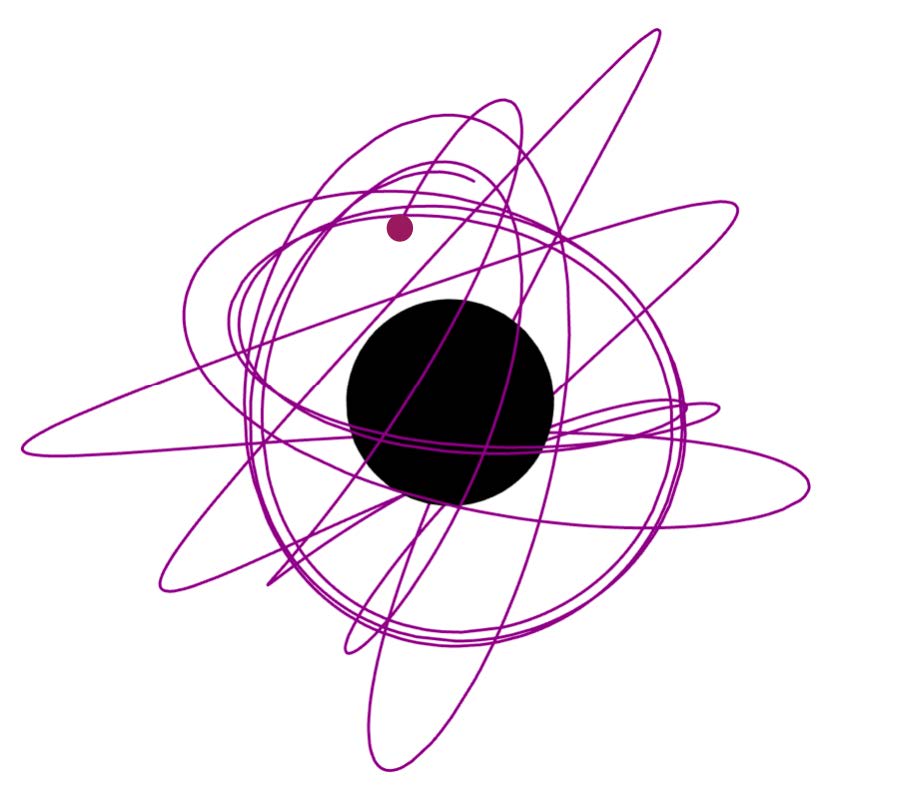
The future space-based gravitational wave (GW) detector LISA, scheduled for launch in 2035, will enable observations of previously unexplored classes of sources. Among its key targets are Extreme Mass-Ratio Inspirals (EMRIs), in which a stellar-mass compact object inspirals into a massive black hole until plunge. During the final years before merger, these systems completes hundreds of thousands of orbital cycles, enabling extremely precise parameter estimation and making EMRIs outstanding probes of fundamental physics in the strong-gravity regime.
In this talk, I will focus on a model of EMRIs in theories of gravity with non-minimally coupled scalar fields. In such theories, at leading (adiabatic) order in the binary mass ratio, deviations from the background Kerr geometry are suppressed, while the scalar charge of the little object captures departures from General Relativity, leaving an imprint on the emitted gravitational wave signal.
I will discuss how this new parameter affects the GW emission and present forecasts for LISA’s ability to detect the presence of the scalar field. Finally, I will address the systematic effects on scalar charge measurability arising from post-adiabatic corrections to the waveform model.
Biography
Susanna Barsanti is a postdoctoral researcher at University College Dublin (UCD), working with Dr Niels Warburton. Her research interest lie in gravitational physics, spanning General Relativity, gravitational waves, black hole physics and alternative theories of gravity.
Susanna earned her PhD from Sapienza University of Rome, under the supervision of Professors Andrea Maselli, Leonardo Gualtieri and Paolo Pani. She then held an Angelo Della Riccia Fellowship at University of Nottingham before joining UCD.
Her research mainly focused on strong-field tests of General Relativity with asymmetric-mass compact binaries such as Extreme Mass-Ratio Inspirals.