SEMINAR 2026
Electrical Detection and Control of AFMR Magnons in van der Waals Heterostructures
| Speaker | Dr Thow Min Jerald Cham, Postdoctoral Research Scholar, Caltech, USA |
| Date/Time | Tuesday, 10 Feb, 3pm |
| Location | S11-02-07 Conference Room |
| Host | Asst/Prof Li Xinwei |
Abstract
The ability to detect and tune the fundamental characteristics and coupling of quantum excitations is a crucial step toward developing future technologies complementary to conventional silicon electronics. The convergence of several key advances makes the present an opportune moment to accelerate the development of functional quantum phases and couplings in van der Waals (vdW) heterostructures. First, the maturation of 2D exfoliation and heterostructure stacking techniques and tuning knobs such as gate voltage have enabled discoveries such as superconductivity in moiré graphene and fractional quantum anomalous Hall states in moiré transition metal dichalcogenides. Second, the library of 2D materials has steadily expanded, with new vdW magnets, ferroelectrics and topological compounds being theorized, synthesized and characterized at a rapid pace. Their intrinsic compatibility with other vdW materials for heterostructure integration offers a vast combinatorial design space for coupling various quantum modes.
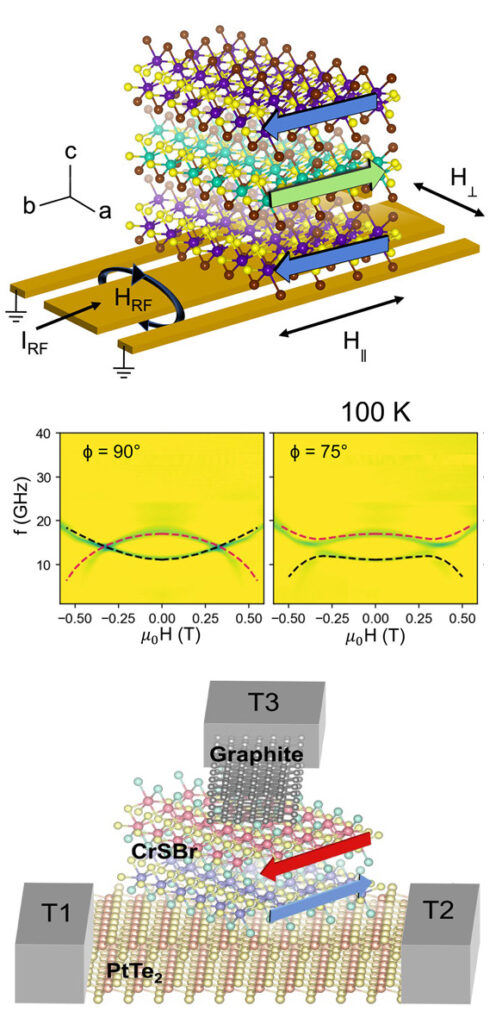
In this talk, I will share recent experimental progress on probing and controlling magnon excitations in antiferromagnets, once thought to be of limited utility due to their net zero magnetic moments. First, we excite and detect antiferromagnetic magnon modes in the A-type vdW antiferromagnet CrSBr arising from triaxial anisotropy with an in-plane easy axis [1]. In this antiferromagnet, we see a much richer variety of magnon modes in contrast to the single Kittel mode in ferromagnets, specifically in-phase acoustic or out-of-phase optical modes, and right-handed or left-handed chiral modes depending on the external field direction relative to the easy axis. Furthermore, we show that the quantum-mechanical hybridization between the two antiferromagnetic modes can be tuned via the angle of the in-plane magnetic field from fully uncoupled to a regime of strong magnon-magnon coupling.
Having developed a good understanding of the magnon properties of the CrSBr system we leverage its vdW characteristics to integrate bilayer CrSBr with a Dirac semimetal PtTe2 and graphene electrical contact layers into a three-terminal heterostructure device [2]. Using a new antiferromagnetic resonance characterization technique based on spin-filter tunneling across the CrSBr layers, we achieved electrical detection of antiferromagnetic resonance in the micron-sized atomically thin bilayer flakes of CrSBr, with sensitivities far exceeding conventional coplanar waveguide ferromagnetic resonance techniques. This innovation also allowed us to generate spin-orbit torques from the adjacent PtTe2 and measure current-modulated resonance damping with a comparable efficiency as ferromagnetic heterostructures. These efforts will elucidate the path towards faster and more efficient on-chip emitters, detectors and memory devices for communication and computing applications.
[1] Cham, T.M.J., Karimeddiny, S., Dismukes, A.H., Roy, X., Ralph, D.C. and Luo, Y.K., 2022. Anisotropic gigahertz antiferromagnetic resonances of the easy-axis van der Waals antiferromagnet CrSBr. Nano Letters, 22(16), pp.6716-6723.
[2] Cham, T.M.J., Chica, D.G., Huang, X., Watanabe, K., Taniguchi, T., Roy, X., Luo, Y.K. and Ralph, D.C., 2025. Spin-filter tunneling detection of antiferromagnetic resonance with electrically tunable damping. Science, 389(6759), pp.479-482.
Biography
Thow Min Jerald Cham is a David and Ellen Lee postdoctoral scholar research associate in the group of Professor David Hsieh at the California Institute of Technology. Before joining Caltech, he received his bachelor’s degree in physics at Imperial College London in 2017, then completed his graduate studies in the group of Professor Daniel Ralph at Cornell University. His research interests lie in combining material and heterostructure engineering with time-resolved spectroscopy and spin resonance measurements, to systematically investigate the characteristic energies and timescales of collective quantum excitations and their functional couplings.
In Cornell’s Laboratory of Solid State and Atomic Physics, his work focused on probing magnetic resonance features in atomically thin 2D antiferromagnetic heterostructures. At Caltech, he is currently working on using ultrafast spectroscopy techniques to uncover evidence of spin excitations in a novel class of magnetic compounds known as kagome spin liquids. By using stroboscopic terahertz spectroscopy and inelastic Raman pump-probe measurements, he aims to uncover the unique signatures of nonequilibrium spin dynamics in these compounds.