
SEMINAR 2025
Topological quantum spin glass order: a new route for quantum memory with realizations in qLDPC codes
| Speaker | Associate Professor Vedika Khemani, Stanford University, USA |
| Date/Time | Friday, 28 Nov, 3pm |
| Location | S11-02-07 Conference Room |
| Host | Asst/Prof Ho Wen Wei |
Abstract
There is a deep connection between ordered phases of matter and models for noise-robust computing and memory in information theory. In particular, the presence of a passive quantum memory is generally associated with a low-temperature thermodynamic phase with thermally stable topological order, which is only known to exist in dimensions D >= 4. I will introduce a new phase of matter – a topological quantum spin glass (TQSG) – which furnishes a new paradigm for quantum memory. Like many conventional models of classical spin-glasses, the TQSG exhibits a provably complex “rugged” free-energy landscape at low temperatures, with numerous local and global minima hosting long-lived equilibrium Gibbs states. Also similar to many classical glasses, the phase transition into the glass phase is dynamical and can take place even as the partition function remains analytic, so there is no (ordinary) thermodynamic ordered phase or phase transition. However, unlike conventional glasses, the TQSG preserves quantum information, and the equilibrium (mixed) states display robust long-range entanglement even at finite temperatures. This phase describes the physics of various novel quantum low density parity check (LDPC) codes, including “good LDPC codes”, which live on non-Euclidean expander graphs, and which have been a topic of much recent interest in quantum error correction. Separately, our work also solves a longstanding problem in classical spin-glasses by furnishing a rigorous proof of a complex landscape and finite temperature spin glass order for finite-connectivity models. Our work opens new avenues in statistical mechanics and quantum computer science, and the study of many-body phases in non-local geometries which are increasingly accessible to modern day quantum simulators.
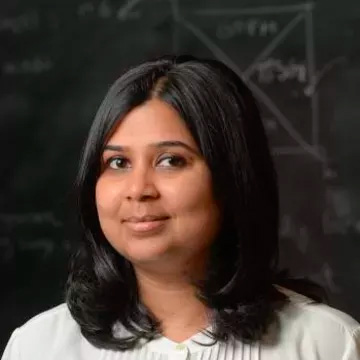
Biography
Vedika Khemani is a theoretical physicist and Associate Professor at Stanford University. Her research lies at the intersection of condensed matter physics and quantum information theory. Prof. Khemani obtained her Ph.D. at Princeton University in 2016, advised by Prof. Shivaji Sondhi. Following that, she was a Junior Fellow at the Harvard Society of Fellows and then joined the faculty at Stanford University, earning tenure in four short years.
Khemani’s work has been recognized by several fellowships and awards: a Sloan Fellowship (2020), the Willam L. McMillan Award (2020), a Packard Fellowship (2021), the APS George E. Valley Jr. Prize (2021), and the Infosys Prize in Physical Sciences (2024). For her work on time crystals, she won the Breakthrough New Horizons Prize in 2022.