
SEMINAR 2025
Challenges in hybridizing post-Newtonian and self-force results
| Speaker | David Trestini, University of Southampton, England |
| Date/Time | Wednesday, 5 Nov, 3pm |
| Location | S11-02-07 Conference Room |
| Host | Asst/Prof Alvin Chua |
Abstract
One of the most interesting sources for LISA are extreme mass ratio inspirals (EMRIs), but these are notoriously challenging to model. The main approach is to solve the Einstein equations pertubatively, in powers of the mass ratio. To obtain accurate waveforms, one requires not only extremely precise models for the adiabatic inspiral (LO in the mass ratio), but also reasonably accurate post-adiabatic waveforms (NLO in the mass ratio). Despite a recent breakthrough, the latter have been extremely difficult to compute throughout parameter space, especially in the dissipative sector – to the point that it is still unclear whether the complete coverage of the parameter space will ready be in time for LISA. In this presentation, I explore the possibility of completing numerical adiabatic eccentric waveforms with post-Newtonian information for the missing post-adiabatic pieces and beyond. Although the resulting hybrid model is less accurate than full post-adibatic waveforms, it could suffice for LISA in a large region of parameter space. The introduction of eccentricity brings many challenges, in particular with respect to gauge invariance and choices of resummations, which I will discuss. In particular, I will present a stepping stone towards the hybrid model: a holistic study of the mapping between fundamental frequencies (radial and azimuthal frequencies) and energy and angular momentum at post-geodesic order.

Biography
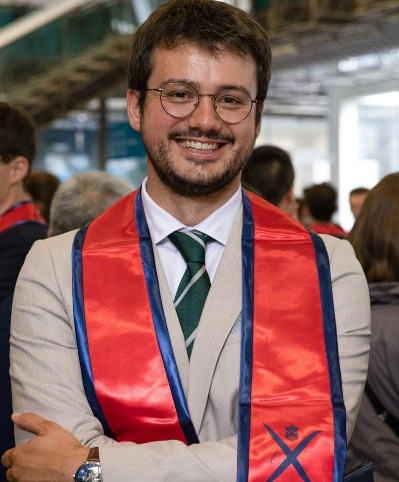
After graduating from l’Ecole polytechnique and the University of Cambridge in 2020, David Trestini started his PhD in Paris (Institut d’Astrophysique de Paris & Laboratoire Théories et Univers) under the supervision Luc Blanchet and Laure Bernard, working on post-Newtonian computations in general relativity and scalar-tensor theories. After defending in 2023, he completed his first postdoc at the Czech Academy of Science in Prague, before joining in 2024 the group led by Adam Pound at the University of Southampton (UK). He is currently mainly interested in post-Newtonian and self-force methods.