Label-free detection and imaging of nanoscopic features in a live cell
Speaker
Prof. Vahid Sandoghdar, Max Planck Institute for the Science of Light, Max-Planck-Zentrum für Physik und Medizin, Germany
Date/Time
Friday, 4 Jul, 3pm
Location
S11-02-07 Conference room
Host
Dr. Jaesuk Hwang
Abstract
While fluorescence labeling remains a powerful tool in biological research, it poses fundamental limitations, which have motivated many groups to develop fluorescence-free measurement methods. Among various contrast mechanisms, scattering offers unique opportunities. About two decades ago, we showed that single gold nanoparticles as small as 5 nm could be detected via interferometric detection of their scattering, coined iSCAT. Since then, it has been shown that unlabeled nano-objects such as proteins and viruses as small as 10kDa can be detected, counted and tracked with iSCAT. We will discuss various applications of this method in characterizing extracellular vesicles and cellular secretomes. Furthermore, I will present our most recent results on three-dimensional label-free imaging of cellular events such as the endoplasmic reticulum and microtubule dynamics as well as virus diffusion via iSCAT microscopy. In addition to our iSCAT work, I will present an efficient method for delivery of nanoparticles and small molecules to well-defined positions on a cell.
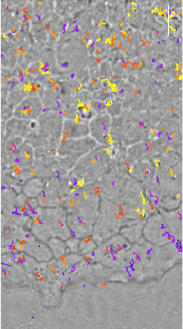
Label-free image of a live cell, identifying endoplasmic reticulae and trajectories of vesicule diffusion. Scale bar is 2 µm.
Biography
Born in Tehran, Iran, Vahid Sandoghdar obtained his B.S. in physics from the University of California at Davis (1987) and Ph.D. in atomic physics from Yale University (1993). After a postdoctoral stay at the Ecole Normale Supérieure in Paris, he moved to the University of Konstanz in Germany to start a new line of research that combined single molecule spectroscopy, scanning probe microscopy and quantum optics. In 2001, he took on a professorship at ETH in Zurich, Switzerland before he became director at the Max Planck Institute for the Science of Light in Erlangen in 2011 and received an Alexander von Humboldt Professorship at Friedrich-Alexander University of Erlangen-Nuremberg in Germany. Sandoghdar is one of the pioneers of Nano-Optics, which merges various research methods to investigate the interaction of light and matter at the nanometer scale. He is the founder of the Max-Planck-Zentrum für Physik und Medizin, a joint research center that addresses questions in fundamental medical research with physical and mathematical methods.