Measuring the strong-field dynamics of asymmetric-mass binary systems with LISA
Speaker
Christian Chapman-Bird, University of Birmingham, UK
Date/Time
Tuesday, 5 Aug, 3pm
Location
S11-02-07 Conference Room
Host
Asst/Prof Alvin Chua
Abstract
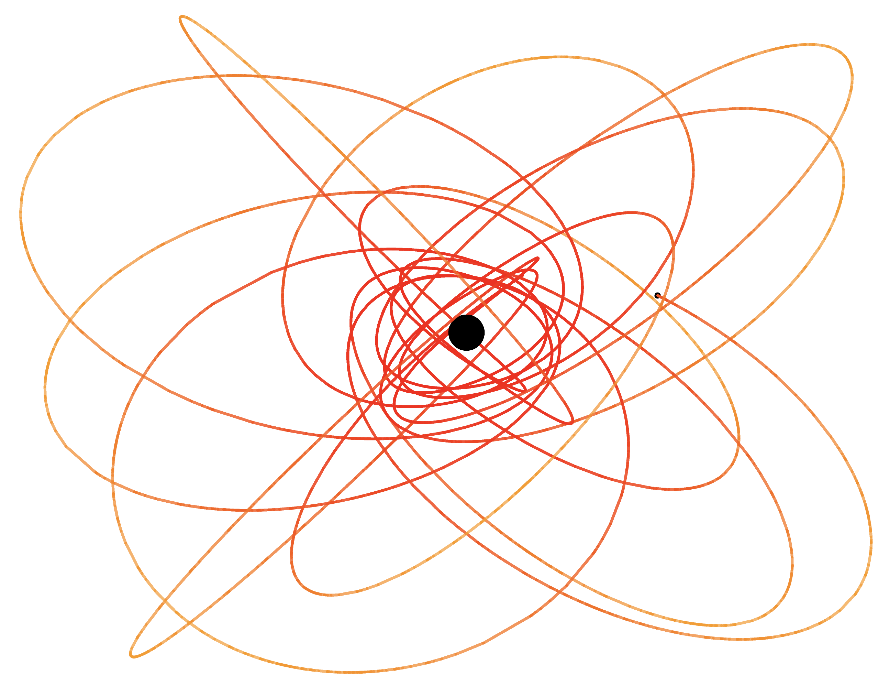
The upcoming Laser Interferometer Space Antenna (LISA) mission will observe many gravitational-wave (GW) sources in the mHz band, including extreme-mass-ratio inspirals (EMRIs) of stellar-mass compact objects into massive black holes (MBHs). These systems exhibit complicated relativistic dynamics as they inspiral over tens of thousands of orbital cycles due to GW emission. This enables their properties to be measured very precisely, but places strong demands on the accuracy of our models for these systems. In this seminar, I will outline how we model the rich dynamics and GW emission of EMRI systems, with a specific focus on providing intuition for how the two are linked. Informed by these cutting-edge models, I will then explore what we can expect to learn from the first EMRI observations with LISA.
Biography
After completing his PhD at the University of Glasgow, Christian joined the University of Birmingham’s Institute for Gravitational-Wave Astronomy as a postdoctoral research fellow in 2024. His work contributes to the the development of waveform modeling and data-analysis techniques for the Laser Interferometer Space Antenna (LISA), a European Space Agency flagship mission set for launch in a decade’s time. His research has particular focus on the modelling of asymmetric-mass binary systems, which pose a significant challenge in both their modelling and subsequent identification in LISA data.