
SEMINAR 2025
Safeguarding Human Chromosome Ends: Homologs RPA and CST’s Distinct Roles in Telomere Maintenance
| Speaker | Ci Ji Lim, University of Wisconsin-Madison, USA |
| Date/Time | Friday, 22 Aug, 3pm |
| Location | S11-02-07 Conference Room |
| Host | Prof Yan Jie |
Abstract
Telomeres, the DNA–protein caps at chromosome ends, are maintained by two molecular systems working on opposite strands. Using cryogenic electron microscopy and biochemical reconstitution, we show how the CST complex organizes DNA polymerase-α–primase into a preinitiation complex optimized for RNA–DNA primer synthesis, positioning the active sites in sequence and enforcing a defined template-length requirement for telomere C-strand fill-in. On the complementary telomere G-strand, we identify Replication Protein A (RPA) as a second telomerase processivity factor, distinct from the TPP1–POT1 recruitment complex. AlphaFold modeling, separation-of-function mutants, and cell assays reveal that RPA directly increases the number of DNA repeats added per telomerase engagement, and that disease-linked telomerase variants impair this boost. These findings define the physical basis for a division of labor at chromosome ends.

Biography
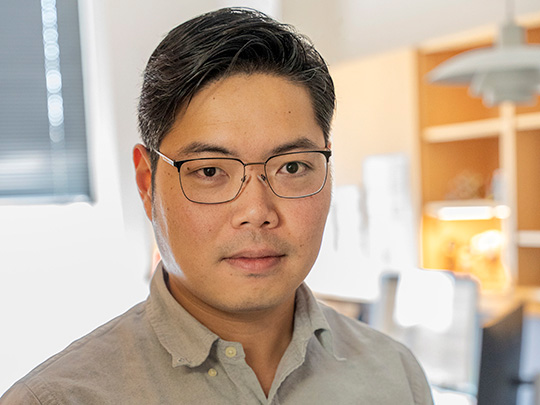
Dr. Ci Ji Lim earned his doctorate in single-molecule biophysics from the National University of Singapore in 2014 under the mentorship of Dr. Jie Yan. He then completed his postdoctoral training in biochemistry with Dr. Tom Cech at the University of Colorado Boulder. In 2020, Dr. Lim joined the Department of Biochemistry at the University of Wisconsin–Madison as a tenure-track assistant professor. The Lim Lab is investigating the structure of human telomeres—the protective caps made of DNA and protein that safeguard the ends of eukaryotic chromosomes. Lim is the recipient of the NIH Pathway to Independent Career Award and the NIH Director’s New Innovator Award, and he has been named a Pew Biomedical Scholar in 2024.