
Research in NUS Department of Physics
The current Department of Physics can be traced back through a long and rich history: its earliest forerunner was founded in 1904 as Straits Settlements and Federated Malay States Government Medical School. It was renamed to Raffles College in 1929 and established as a proper university as University of Malaya in 1949. After a further renaming to University of Singapore in 1962 and a merger with Nanyang University in the year 1980, the National University of Singapore was established. It is worth mentioning that famous physicists visited the department, such as Paul A. M. Dirac – a picture of him during a lecture is on display still in the departmental meeting room.
Until around 1990, the department was essentially a teaching department with little research activities. At that time, NUS began to transform itself into a research university. Over these past two decades, tremendous efforts have been made in developing the research capabilities of our department, which is now classified as “research intensive”.
There are several unique groups in our department, firstly the Centre for Quantum Technologies (CQT), which originated in the physics department and is now a separate research centre, the first Research Centre of Excellence (RCE) funded by the Singapore government. Recently the Centre for Advanced 2D Materials and Graphene Research Centre was set up to spearhead graphene and 2D materials research. The Centre for Ion Beam Application (CIBA) is a unique entity, dedicated to ion beam applications. Many of our faculty members have very active research programmes and have produced high impact research work. Some of them hold editorial positions at prestigious journals and are elite members of professional organizations (such as APS or IoP fellows).
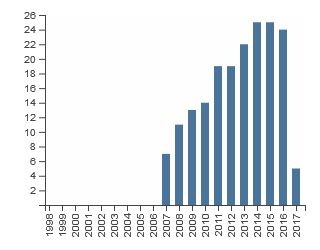
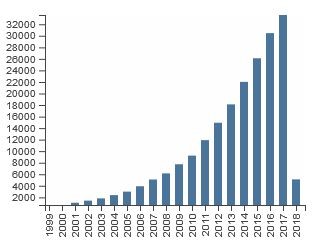
The 2017 and 2018 “QS world university ranking by subjects” has ranked NUS physics at the 25th position in the physics and astronomy category. Over the years, the research output produced by the department has grown quite strongly, as shown in figure 1 below. The figure indicates the number of journal publications indexed by the Web of Science with an author/coauthor from our department. Clearly, tremendous progress has been made.
Research Areas
The Department of Physics at the National University of Singapore promotes excellence in a range of research areas, including condensed matter physics, surface physics, materials science, high energy physics, atomic physics, superconductors, solid-state ionics, astrophysics, infrared spectroscopy, laser optics, X-ray fluorescence, ion beam physics, optics, acoustics and computer simulations.
Our aim in research development is to both acquire new knowledge in fundamental areas and to tackle problems of relevance to Singapore’s industry. The Physics Department sees a major role for itself in the national effort to advance Singapore into a high-tech era. To this end, many staff conduct collaborative, multi-disciplinary research work with industry, overseas universities and government ministries.
The Physics Department has many laboratories which are equipped with excellent research facilities, such as the Surface Science Laboratory, Centre for Ion Beam Applications (CIBA), Centre for Superconducting Magnetic Materials (CSMM) and Laser Spectroscopy Laboratory. In addition, the Department has a well-equipped workshop to support the research activities and three Computer and Applications Laboratories with 200 high-power workstations and PCs, and scientific and advanced visualization software.
There are about 55 staff members who are actively involved in research work besides their primary teaching duties. The number of postgraduate students is about 150. Annual funding from the university, industry and government agencies, for new and ongoing research projects exceeds S$15 million. The Department’s excellence in research has been demonstrated by more than 3,000 high-impact publications in the last 10 years, with an h-index ~150.