
Modelling nonequilibrium nanoscale junctions with steady-state DFT
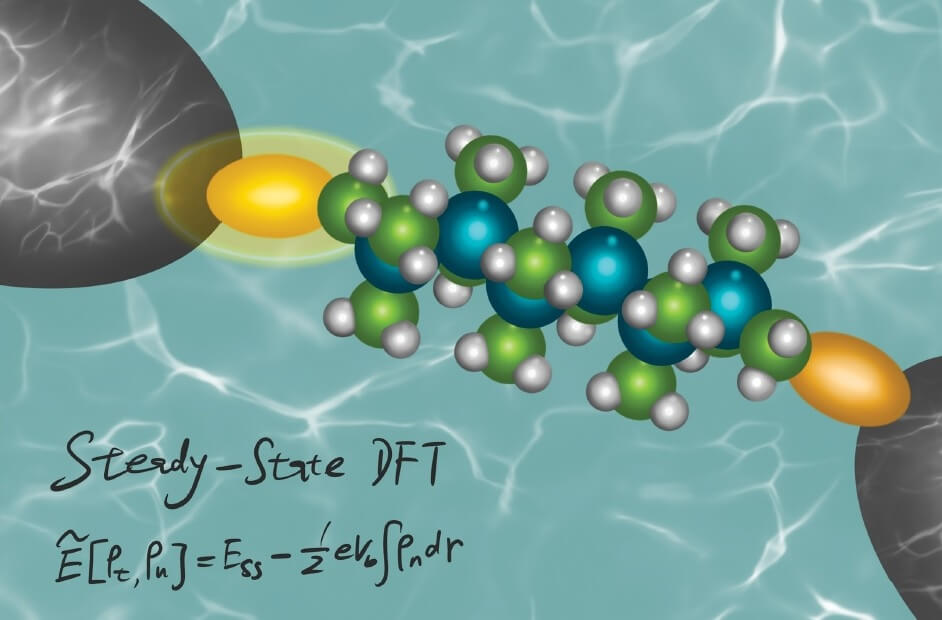
NUS physicists have predicted a new type of nonequilibrium effects that could generally exist in nanoscale electronic devices, and successfully explained a recent puzzling experiment using the effects.
Understanding bias-induced nonequilibrium effects on electron transport properties of nanoscale junctions is the central issue of computational nanoscience. The standard density functional theory (DFT) based first-principles method that combines DFT and nonequilibrium Green’s functions’ techniques has been widely used in modelling nonequilibrium nanoscale devices, providing qualitative understanding of experiments by linking the measured conductance to tunnelling of electrons through ‘molecular’ orbitals of the devices. A recent experiment, however, reported surprising transport phenomena through silanes junctions that cannot be understood by the standard DFT method. Therein the low-bias conductance of various silanes molecules with different linker groups (amine or thiol) bridging different metal electrodes (Au or Ag) were measured. It was found that with the amine linker, Au electrode generates much higher conductance than Ag, while with the thiol linker, the trend reverses that Ag electrode is significantly more conducting than Au. In contrast, DFT-based calculations predict that Au electrode is always more conducting than Ag regardless of linkers. This contradiction between theory and experiment presents the community of computational nanoscience with a severe challenge.
To address this challenge, Prof Zhang Chun’s group theoretically studied the transport properties of silanes junctions using the steady-state DFT that was proposed by Prof Zhang in 2015. The steady-state DFT considers nonequilibrium effects in full by employing nonequilibrium quantum statistics. They found that underlying the puzzling experimental observations is a novel type of nonequilibrium effects (named ‘nonequilibrium pulling’ in their work) that exist in silanes junctions with thiol linkers. Their calculations show that when the junction is near equilibrium, the standard DFT method is an excellent approximation of SS-DFT, while the ‘nonequilibrium pulling’ drives the thiol-terminated silanes far away from equilibrium at low biases around 0.2 V, resulting in the trend reversal of conductance observed in experiments. Further analysis suggests that these nonequilibrium effects could generally exist in nanoscale devices in which there are conducting channels mainly residing at the source contact and being close to the bias window. These findings significantly broaden our fundamental understanding of electron transport at nanoscale.

The figure shows the conceptual difference between steady-state DFT and the standard DFT method. In steady-state DFT, the transport state is a functional of two densities, the total electron density ρt and the current-carrying electron density ρn, while the standard DFT is ‘one-dimensional’ that the transport state is only determined by ρt. The 2D color contour represents the energy of the steady-state transport state Ess. Steady-state DFT searches for the most stable transport state in the 2D plane while the standard DFT does the search along ρt axis. When the system is near equilibrium, ρn is small and the searching path of steady-state DFT is close to the ρt axis. In this case, DFT method can be a good approximation.
Reference
Jiang Z; Yam KM; Guo N; Zhang L; Shen L; Zhang C*, “Prominent nonequilibrium effects beyond the standard first-principles approach in nanoscale electronic devices”, NANOSCALE HORIZONS Volume: 6, Page number: 801-808 DOI: 10.1039/d1nh00293g
rsc.li/nanoscale-horizons Published: 2021.