
My academic journey at NUS
Kang Joon Kiat [PhD 2026]
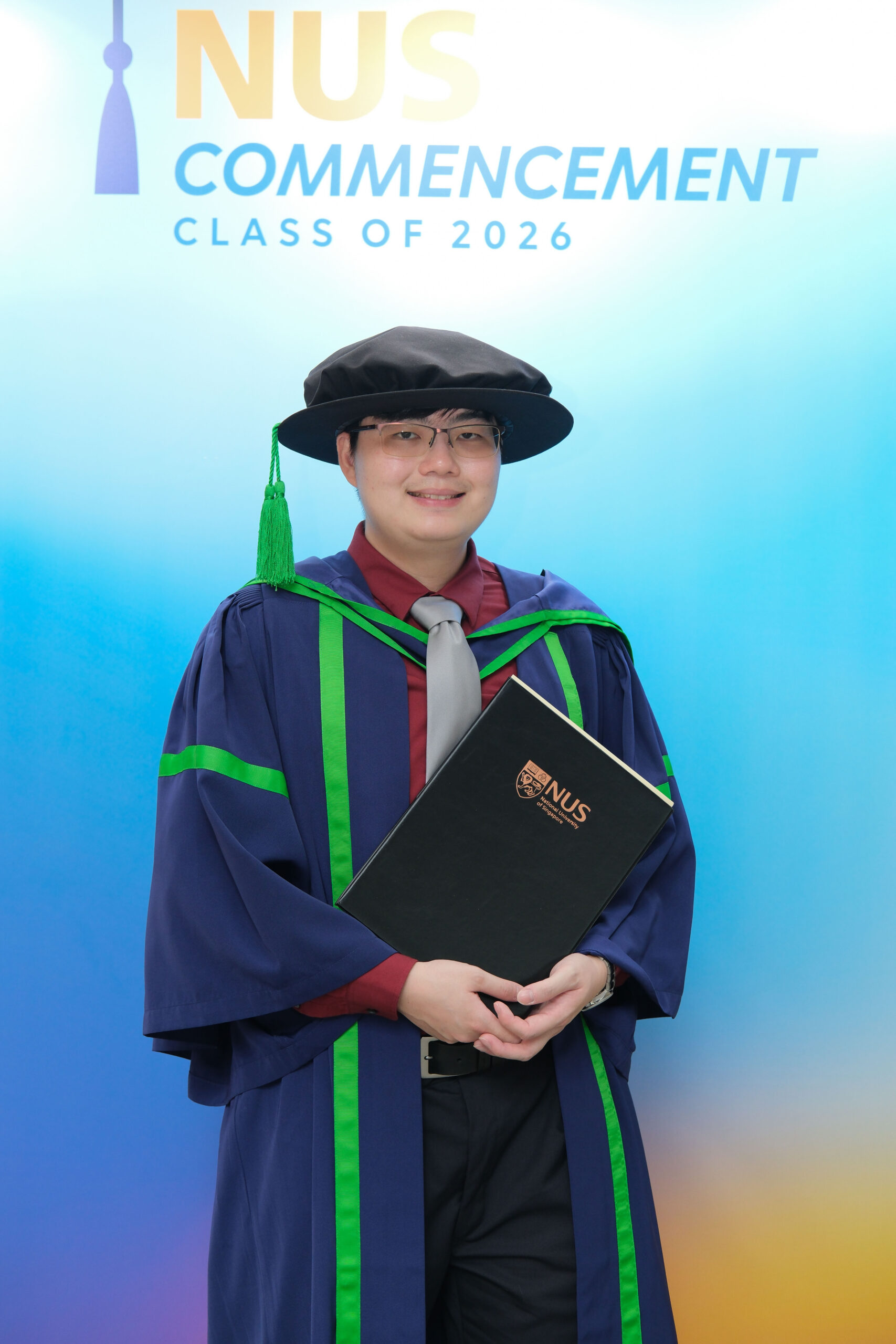
I was fortunate enough to receive an early exposure to research in a supportive environment. As part of the Special Programme in Science (SPS) journey, I first had a taste of experimental physics research in Prof Sow Chorng Haur’s lab during my first year of undergraduate studies. Subsequently, I returned to the same lab for a second project in my second year of SPS and my final year project in Honours year.
Prof Sow and the many folks at Nanomaterials Research Lab were very supportive and friendly. That went a long way towards nurturing an interest in nanomaterials research. Honestly, I had no preference whatsoever in any particular field of physics before trying my hand at research. However, the more involved I became in the process—learning how to operate materials characterisation equipment, designing experiments, digging up solid state theory to understand results—the more interested I became in nanomaterials. At the end of the four years, that interest was sufficiently strong to entice me into challenging myself to discover something entirely new.
Over the course of my PhD, my biggest takeaway was developing an emotional indifference towards uncertainty. The nature of a PhD is such that one is finding answers nobody knows to questions nobody has asked before. A candidate can never be completely sure that they are asking the right questions, let alone whether the answers they have found are correct. That uncertainty can be paralysing, but one must still venture forth as best one can. I learned to let that uncertainty wash over me while developing the best possible plans and contingencies given the suboptimal completeness of the information I have available. The uncertainty must be acknowledged and dealt with, but emotionally disconnecting from it is important for one’s sanity and efficiency.
My second takeaway was project planning experience. Ignoring the technical specifics, all PhDs are essentially projects with expected but nebulous deliverables within a finite time frame. Four years is really not that much time. While I did gain experience during my undergraduate years in optimising my workflows for efficiency with respect to time and effort, it was during my PhD that I pushed that notion to the extreme. It was a one-person project, so every second of data collection time was valuable. I needed to have sufficient volume of data to identify trends and ensure repeatability. It certainly did not help that my project centred on a material that was deliberately flooded with defects and therefore exhibited extreme variance in properties. That said, energy was also a finite resource. The more tired I get, the higher my error rate climbed, and errors would only cost additional time in the future. It is important to examine whether the payoff for high-effort measures is worth the energy. And sometimes, it is prudent to give up on directions that refuse to return results, painful though it may be to let go of the sunk cost.
On a more technical level, my third takeaway was developing the confidence to trust in my own data analysis. There were no prior experiments for which I could cross-check my conclusions one-to-one which could make it unnerving to design subsequent experimental stages. The best I could do was to ensure my methodology and analysis were as grounded and watertight as possible at every step. Over time, I increased the rigour of my experiments and learned to trust my work more. Even if the conclusions I came to seem fantastical on the surface, if the data supported it, and the methodology used to obtain that data was sound, then it was probably accurate (until otherwise disproven).
The most satisfying outcome from my research was discovering spatially homogenous polarised defect fluorescence on a mesoscopic scale in carbon-incorporated zinc oxide nanowires. Defect fluorescence is typically unpolarised due to the randomness of their formation. Polarised fluorescence would imply the presence of an emitting species that not only possesses a non-zero transition dipole moment, but is also oriented in a common direction across a large enough spatial extent or in large enough concentration to produce a coherent, measurable signal. This is rather out-of-character for defect fluorescence. In my case, I observed polarised defect fluorescence continuously along nanowires up to 10 microns long, which further added to the incredulity. By combining several characterisation techniques and consulting computational calculations, we identified one defect complex as the responsible source and discerned an emission mechanism that was satisfyingly complete.
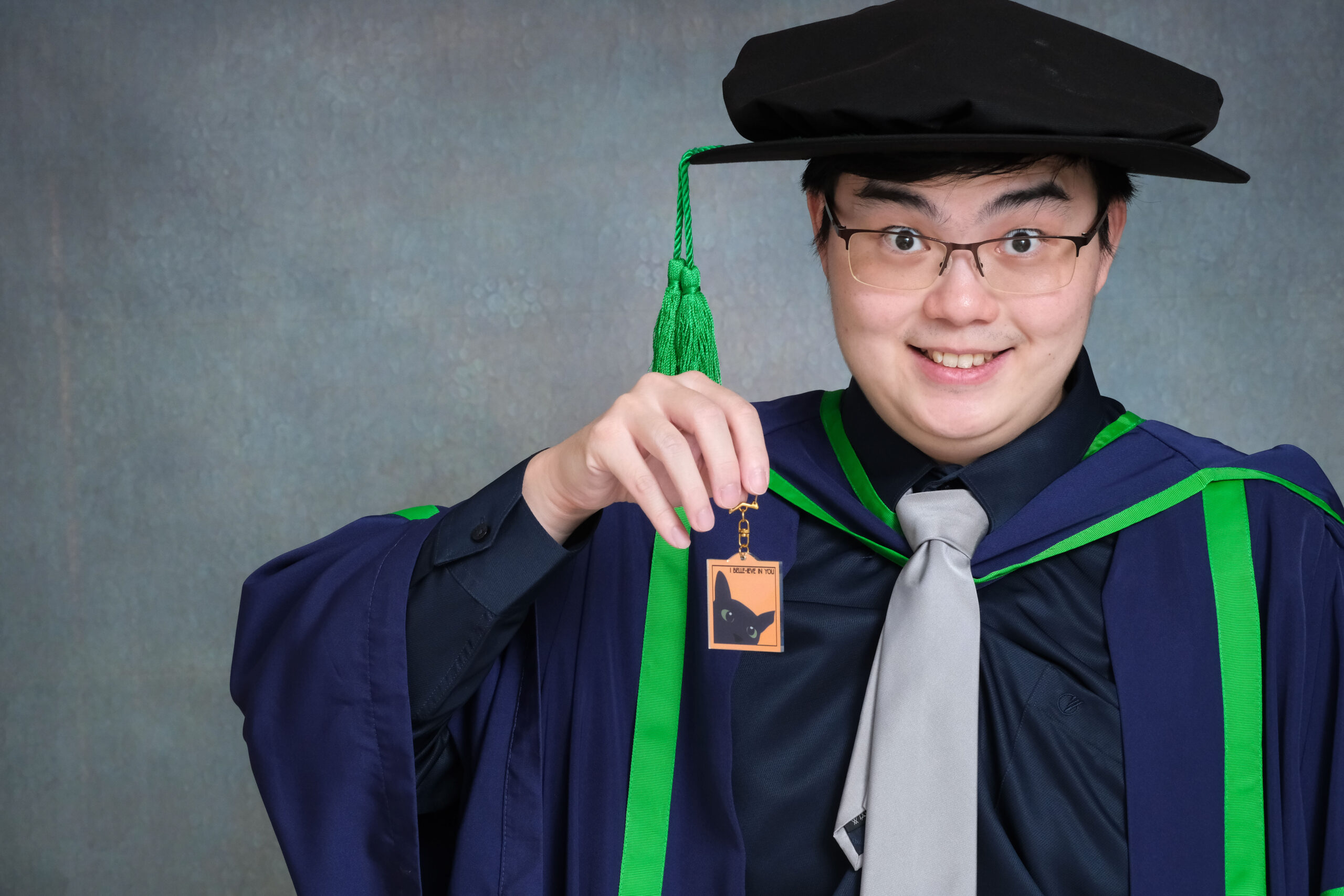
On a more personal level, I befriended a cat during my time in NUS. She was the highlight of my day. You might have seen a black cat lounging around in Science between LT27 and the Frontier canteen. You might also have spotted a bloke who would sit on the ground with the cat. I first chanced upon her on my way home one night during my second undergraduate year. Subsequently, I noticed the same black cat lying around Science, and started looking for her every day. Sitting with her became a daily pocket of calm for me amidst the long hours of academic work. Eventually she came to recognise me and would come running over whenever she heard my special whistle for her. She would lead me on night walks around the campus, walking ahead of me and looking back to make sure I was not falling behind. At one point she climbed into my lap. A year later, she would sleep on my leg every time I met her. It meant delaying my journey home by at least two hours, but it was very endearing to me.
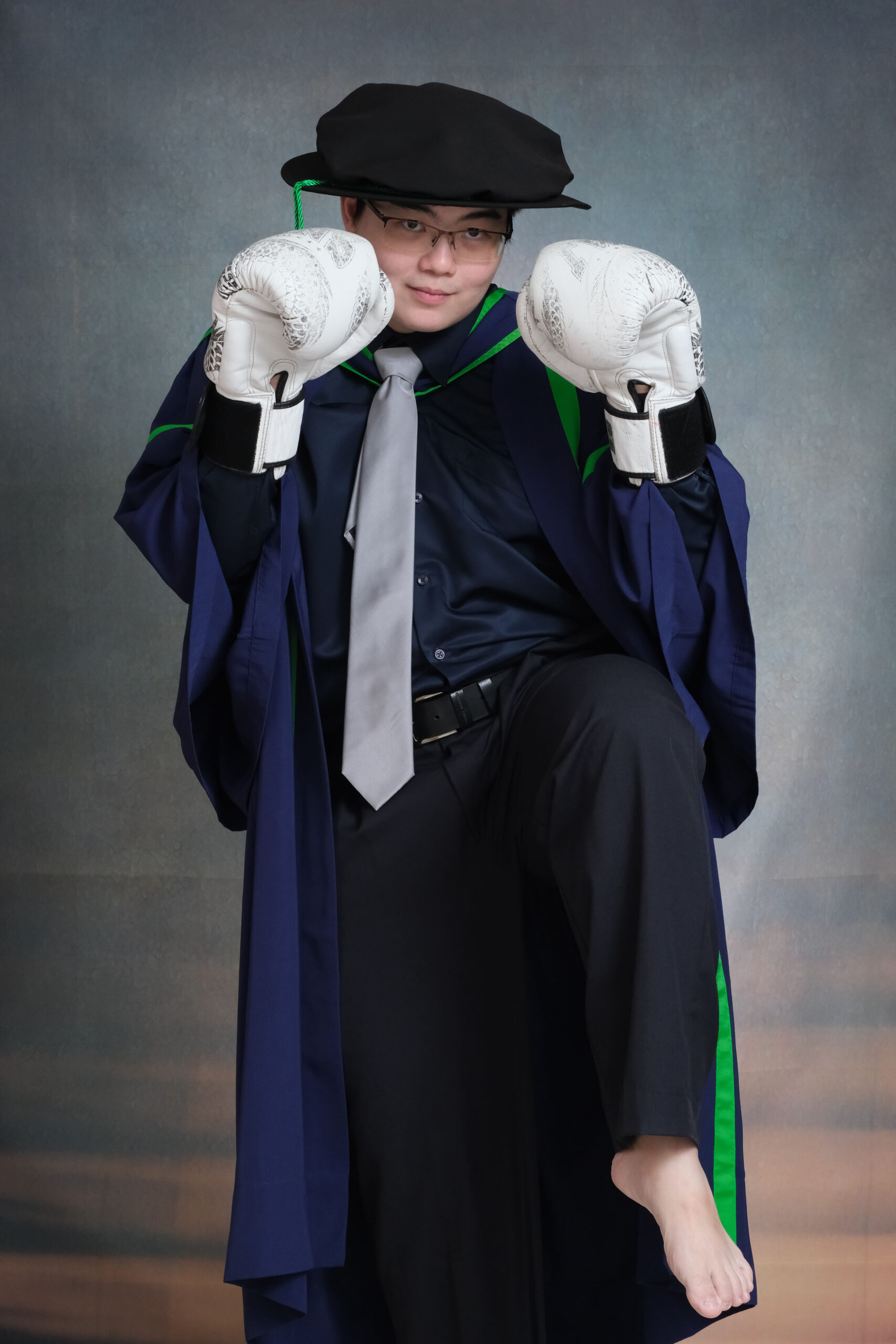
After I completed my PhD, I turn my attention to exercise (which also gave me an opportunity to catch up on my favourite shows 😅) to keep myself fit. I now fully embrace my work as a process engineer at Applied Materials under the Dielectric Deposition business unit of Advanced Packaging Development Center. We primarily work with chemical vapour deposition, a synthesis method I used earlier in my research to fabricate my zinc oxide samples. However, instead of crystalline semiconductors, I deal mainly with amorphous dielectric films. There are overlaps, and I have much more to relearn regarding the physics of amorphous insulators. I am glad to be able to carry my knowledge regarding characterisation methods, material properties, and physical processes with me during deposition. My bosses hope the physical intuition I bring to the team will help to speed up troubleshooting and process development, and reduce reliance on trial and error.
I would like to sincerely thank Prof Sow Chorng Haur and Dr Lim Kim Yong for their many years of close guidance and support. When I first stepped into Nanolab, I had no idea what I was doing. Your guidance moulded me into the researcher I am today. I would also like to thank Dr Sharon Lim, Dr Poh Eng Tuan, and my friends at Nanolab for making the lab a warm and supportive environment to work in.
While I did gain experience during my undergraduate years in optimising my workflows for efficiency with respect to time and effort, it was during my PhD that I pushed that notion to the extreme.
Kang Joon Kiat
Read Joon Kiat’s undergraduate journey here.