
GRADUATE SEMINAR 2
Chiral Nanostructures
| Speaker | Professor Nicholas A. Kotov, University of Michigan, Ann Arbor, USA |
| Date/Time | Tuesday, 13 Oct, 10am |
| Location | Seminar Room S1A-02-17 |
| Moderator | Dr Nidhi Sharma |
Abstract
Chiral nanoparticles and assemblies represent a large and rapidly evolving class of biomimetic materials. They change the perception of chirality in chemistry, and they enable the facile synthesis of chemical structures with previously inaccessible complexity and structural sophistication. Chiral nanostructures also offer novel technological venues for information and biomedical technologies due to 10-1000 times increase in magnitude of polarization rotation compared to classical chiral materials [1,2].
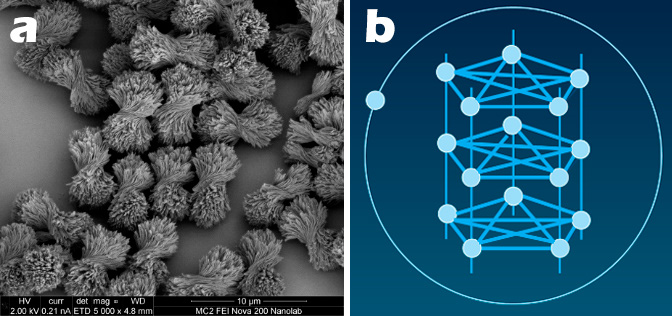
From the early 1800s, scientists put large effort into synthesizing molecules with escalating complexity replicating molecules in living organisms. Self-assembly of chiral nanoparticles has emerged as the pathway toward complex chemical structures with not only molecular sophistication, but also with multiscale hierarchical organization closely mimicking biological structures. As such, chiral nanosheets used as building blocks afford hedgehog particles and bowtie particles (Fig. 1a [3]). Graph Theory (GT) provides the critical quantitative framework for quantification of complexity (Fig. 1b); the complexity indices computed from minimal graph representations enable direct comparison with biological counterparts, such as nanoscale viruses and microscale coccoliths.
Also, chiral nanostructures display giant circular dichroism due to 107 time increase in dynamic polarizability of the inorganic materials. Instead of the binary chirality of, for instance, L– or D-amino acids [1-3], the chiral nanoparticles and their assemblies display a continuum of chiral states Studies from multiple groups indicated that the size, geometry, and composition of chiral nanostructures can be tuned to resonate with a wide range of photon energies from ultraviolet to terahertz.
Further studies of nanostructures with finely controlled degrees of left- and right-handedness provide impetus to understanding the role of chirality, not only in chemistry, but also in physics, biology, and medicine. For example, black body radiation from twisted nanoscale fibers was found to be strongly circularly polarized which was not anticipated by the classical theories using macroscale spheres as model emitters [4]. Taking advantage of unified GT description of proteins and nanoparticles, chiral nanostructures can be engineered similarly to protein assemblies to selectively interact with biological counterparts of a similar scale [5]. The strength and selectivity of their interactions can be varied by nanoparticle geometry, and surface ligands, with subsequent utilization in medicine [6], which can be boosted by the development of GT-based and other scale-dependent chirality descriptors.
References
[1] W. Chen et al.; Nanoparticle Superstructures Made by Polymerase Chain Reaction: Collective Interactions of Nanoparticles and a New Principle for Chiral Materials. Nano Lett., 2009, 9, 2153–2159.
[2] W.J. Choi, et al, Chiroptical Kirigami Modulators for Terahertz Circular Dichroism Spectroscopy of Biomaterials, Nature Materials, 2019, 18, 820–826.
[3] W. Jiang, et al; Emergence of Complexity in Hierarchically Organized Chiral Particles, Science, 2020, 368, 6491, 642-648.
[3] P. Kumar et al; Photonically Active Bowtie Nanoassemblies with Chirality Continuum, Nature, 2023, 615, 418-424.
[4] J. Lu et al; Bright, circularly-polarized black body radiation from twisted nanocarbon filaments, Science, 2024, 386, 6728, 1400-1404.
[5] M. Cha et al, Unifying Structural Descriptors for Biological and Bioinspired Nanoscale Complexes, Nature Computational Science, 2022, 2, 243–252.
[6] L. Xu, et al; Enantiomer-Dependent Immunological Response of Nanoparticles with Light-Induced Chirality, Nature, 2022, 601, 366–373.

Biography
Nicholas A. Kotov pioneered complex biomimetic nanomaterials, represented by layered composites and chiral nanostructures. He demonstrated that geometrically asymmetric nanoparticles can self-assemble into superstructures with structural complexity that may exceed that of evolution-optimized biomaterials and organelles. The graph-theoretical (GT) representations of biomimetic composites and the giant ellipticity of chiral nanostructures are the focal points of his current work. Nicholas founded several start-ups that commercialized self-assembled nanocomposites and chiral superstructures for energy and healthcare technologies. Nicholas Kotov is a recipient of over 60 national and international awards, including the Centenary Prize from the Royal Society of Chemistry, the Chirality Medal from the Società Chimica Italiana, the Colloids and Surface Award from the American Chemical Society, Chemistry of Materials Award from the American Chemical Society and the Newton Award from the US Department of Defense. Nicholas Kotov is a Fellow of the National Academy of Engineering, the American Academy of Inventors, and the American Academy of Arts and Sciences.