Twistronics: from single-particle electronic states to many-body models in twisted bi-layer graphene
Speaker
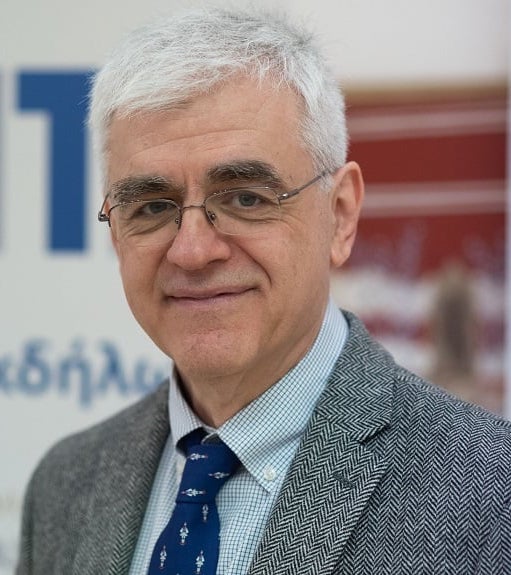
Professor Efthimios Kaxiras, Harvard University, USA
Date/Time
Thursday, 5 Feb, 4pm
Location
LT33
Moderator
Asst/Prof Steven Touzard
Abstract
The field of “twistronics” was born with the experimental discovery of correlated electron behavior and super-conductivity in twisted bilayer graphene. Since then, a great number of new systems have been observed, consisting of two or more twisted layers and exhibiting a wide range of interesting electronic behavior. In this seminar we will concentrate on twisted bilayer graphene and discuss how the computation of realistic single-particle electronic states is essential in constructing many-body models for describing correlated electron behavior. We will focus on the nature of single-particle states as a function of twist angle and inter-layer interaction, to motivate the importance of capturing accurately many-body behavior. We will also explore the construction of effective tight-biding hamiltonians that can serve as the basis for many-electron system behavior.
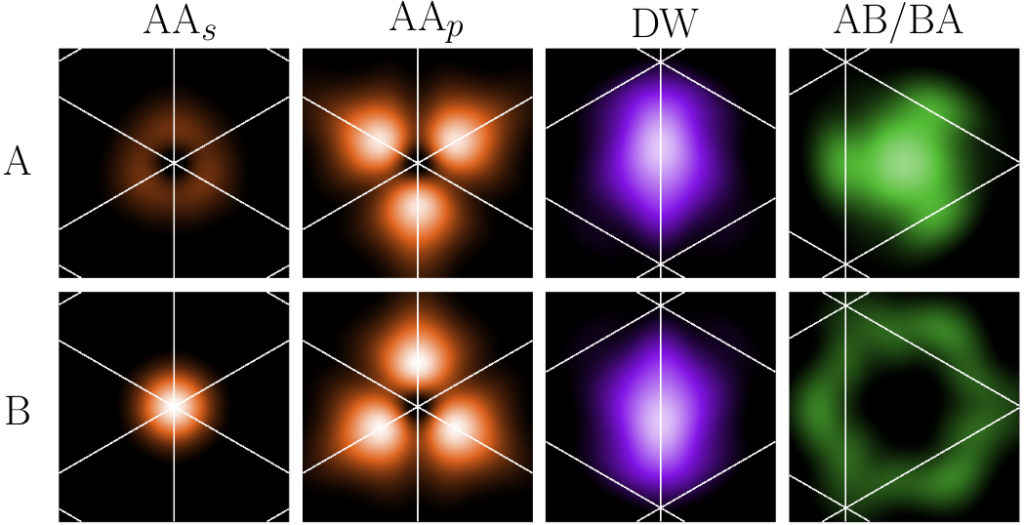
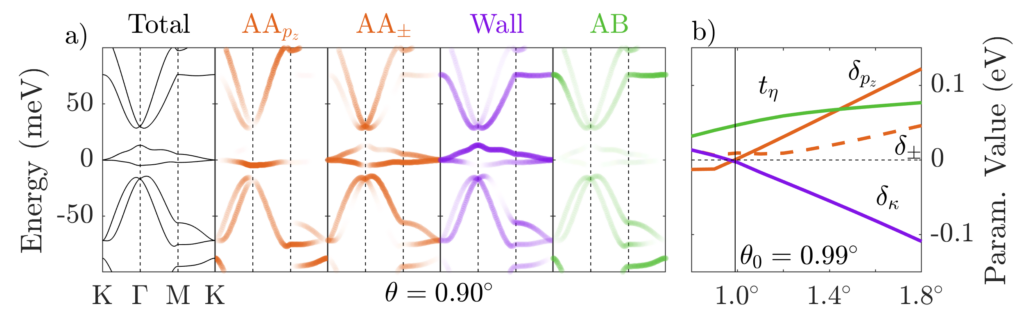
Electron wave-functions for various localized states (top panles), corresponding to AA (orange), domain wall (purple) and AB/BA domains (green), and their projection (bottom panels) on the flat bands and the nearby dispersive bands, for mgaic angle twisted bilayer graphene.
Biography
Efthimios Kaxiras received his PhD in theoretical condensed matter physics from MIT. He is presently the John Hasbrouck Van Vleck Professor of Pure and Applied Physics at Harvard University. He has been a Visiting Faculty at ETH-Zurich, EPF-Lausanne, the University of Ioannina and the University of Crete. He has served as Director of Harvard’s Institute for Applied Computational Science and the Initiative in Innovative Computing. He holds several distinctions such as Fellow of the American Physical Society and Chartered Physicist and Fellow of the Institute of Physics (London).
He has published widely in the area of computational materials science with emphasis on multiscale simulations of complex physical phenomena. He has also written two textbooks on the physics of solids. His recent research focuses on the extraordinary properties of two-dimensional, layered materials and in particular on the topic of twistronics (a term introduced by his research group).