

Efthimios Kaxiras
Harvard University
February 2026
Pablo Jarillo-Herrero
MIT
July 2025
Cees Dekker
TU Delft
November 2024
Jens Gundlach
University of Washington
October 2024
Efthimios Kaxiras
Harvard University
February 2026
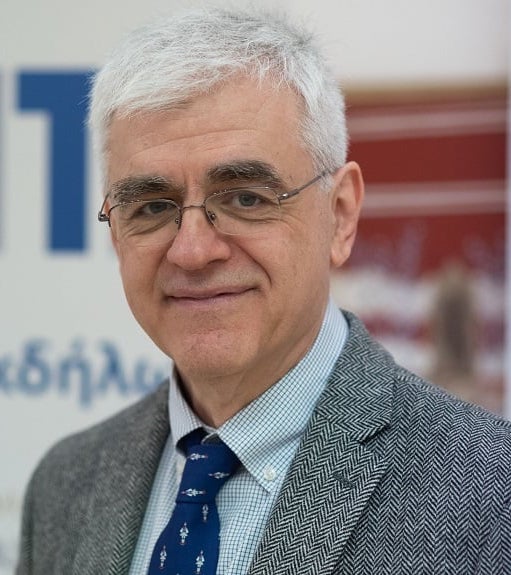
Efthimios Kaxiras received his PhD in theoretical condensed matter physics from MIT. He is presently the John Hasbrouck Van Vleck Professor of Pure and Applied Physics at Harvard University. He has been a Visiting Faculty at ETH-Zurich, EPF-Lausanne, the University of Ioannina and the University of Crete. He has served as Director of Harvard’s Institute for Applied Computational Science and the Initiative in Innovative Computing. He holds several distinctions such as Fellow of the American Physical Society and Chartered Physicist and Fellow of the Institute of Physics (London).
He has published widely in the area of computational materials science with emphasis on multiscale simulations of complex physical phenomena. He has also written two textbooks on the physics of solids. His recent research focuses on the extraordinary properties of two-dimensional, layered materials and in particular on the topic of twistronics (a term introduced by his research group).
Pablo Jarillo-Herrero
MIT
July 2025
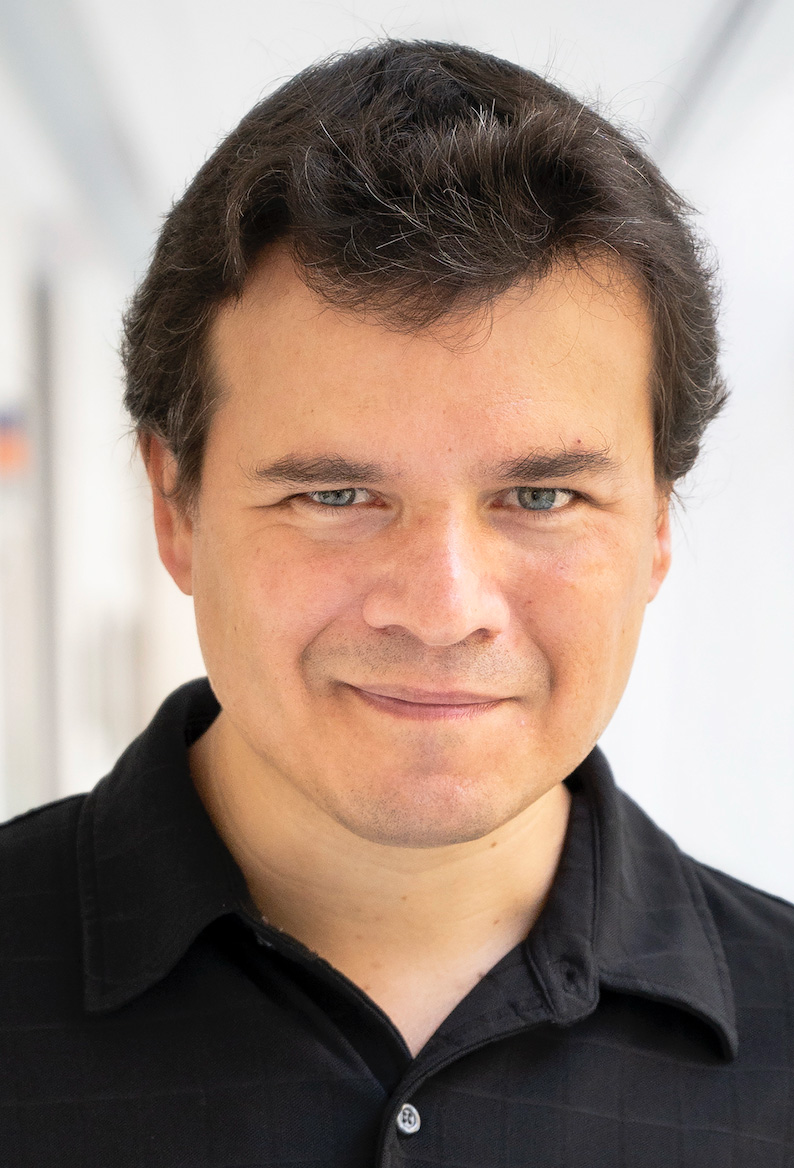
Pablo Jarillo-Herrero is currently Cecil and Ida Green Professor of Physics at MIT. He received his “Licenciatura” in physics from the University of Valencia, Spain, in 1999, and his PhD in physics from Delft University of Technology in The Netherlands in 2005. After his postdoc at Columbia University, he joined MIT as an assistant professor of physics in January 2008 and received tenure in 2015. He was promoted to Full Professor of Physics in 2018.
Prof. Jarillo-Herrero is the recipient of the APS 2020 Oliver E. Buckley Condensed Matter Physics Prize, the 2020 Wolf Prize in Physics, the 2020 Medal of the Spanish Royal Physics Society, the 2021 Lise Meitner Distinguished Lecture and Medal, the 2021 Max Planck Humboldt Research Award, the 2021 US National Academy of Sciences Award for Scientific Discovery, the 2022 Dan Maydan Prize in Nanoscience Research, and the 2023 Ramon y Cajal Medal from the Royal Spanish Academy of Sciences. He is a member of the US National Academy of Sciences (2022), the Spanish Royal Academy of Sciences (2023), and the European Academy of Sciences (2025).
Professor Jarillo-Herrero’s research interests lie in the area of experimental condensed matter physics.
Cees Dekker
TU Delft
November 2024
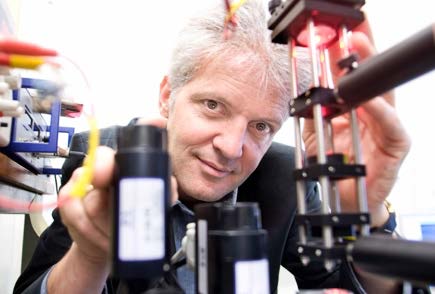
Cees Dekker is a physicist who moved from quantum solid-state physics to nanobiology. In the 1990s, he pioneered nanotechnology and discovered many of the exciting electronic properties of carbon nanotubes, establishing the first single-molecule transistor. In 2000, he moved to single-molecule biophysics and nanobiology, applying nanotechnology to biological systems and enforcing various breakthroughs from DNA and protein sequencing with nanopores to DNA loop extrusion by novel motor proteins. His current research focuses on nanopores, chromosome structure, and developing synthetic cells. Characteristically, Dekker pioneers new fields and defines new directions, both organizationally in e.g. establishing the Kavli Institute and a new Department of Bionanoscience at Delft and spearheading international initiatives to build synthetic cells, but more importantly also scientifically – by pioneering molecular electronics and nanobiology yielding major discoveries from nanopore sequencing to DNA loop extrusion by motor proteins.
Jens Gundlach
University of Washington
October 2024

Jens Gundlach is Professor of Physics at the University of Washington in Seattle. He studied physics at the Johannes Gutenberg University in Mainz, Germany, and earned his Ph.D. in nuclear physics from the University of Washington. He then became interested in testing fundamental aspects of gravity. His group is well-known for the best tests of the equivalence principle, measurements of gravity at sub-millimetre separations and for inventing a more precise method to measure Newton’s constant, big G. His group also develops instrumentation to aid gravitational wave detection.
In 2004, Dr. Gundlach became interested in biophysics and soon emerged with breakthrough achievements. His group was first to demonstrate functional nanopore sequencing of DNA, which thereafter became a commercially available technology. Gundlach’s group then went on to develop an ultra-precise single-molecule tool to resolve the activity of enzymes with unprecedented precision.
With an attitude that nothing is impossible, Dr. Gundlach now runs two world-leading labs in diametrically opposite fields of physics.
In 2021 he was awarded the Breakthrough Prize in Fundamental Physics for his work on gravity.