
COLLOQUIUM 2026
Emerging Paradigms in Topological Quantum and Photonic Matter
| Speaker | Dr. Sachin Vaidya, Department of Physics, Massachusetts Institute of Technology, USA |
| Date/Time | Tuesday, 8 Sep, 10:30am |
| Location | Webinar |
| Host | A/Prof LEE Ching Hua |
Abstract
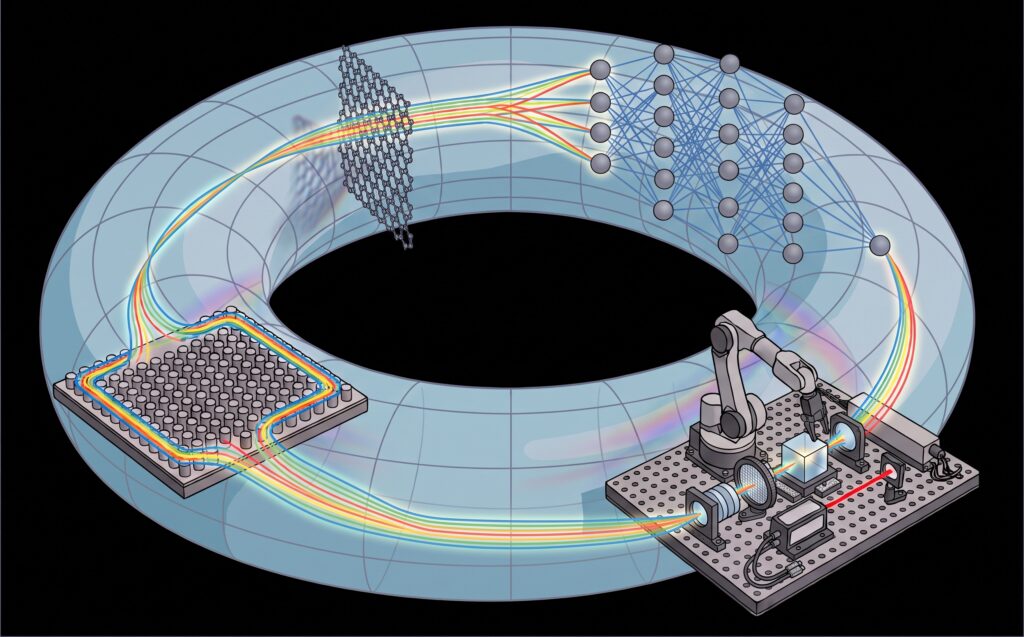
A recurring theme in modern physics is that complex systems can often be understood through remarkably simple laws. Recent advances in condensed matter physics and photonics have shown how symmetry and topology can serve as organizing principles across a range of physical systems. At the same time, advances in artificial intelligence (AI) are creating emerging paradigms for discovering such underlying principles directly from data. In this talk, I will explore both directions: new manifestations of topology in quantum and photonic matter, and new approaches for uncovering the rules that govern them.
In the first part of the talk, I will show how topology can emerge in unconventional physical settings. I will discuss unusual symmetries acting in momentum space that can twist it into non-orientable manifolds. This gives rise to novel topological phases with quantized responses to lattice deformations such as strain and shear. I will then discuss nonlinear, driven-dissipative quantum optical systems, where non-Hermitian topology can be used to robustly control the dynamics of quantum noise. This produces directional transport of fluctuations and offers a distinct pathway towards generating low-noise quantum states of light.
In the second part of the talk, I will turn to new paradigms for physical discovery. I will introduce Kolmogorov-Arnold Networks (KANs), an AI architecture designed to extract interpretable relationships from data, taking a step beyond traditional “black-box” models. I will show applications of KANs for finding structure-property relationships in topological photonics and interacting electronic systems. As data-driven methods increase the rate of hypothesis generation, however, the ability to experimentally test them becomes a major bottleneck. I will conclude with our recent efforts towards autonomous experimentation in optics using robotics, illustrating how these capabilities hold the potential to accelerate discoveries across physics.
Biography
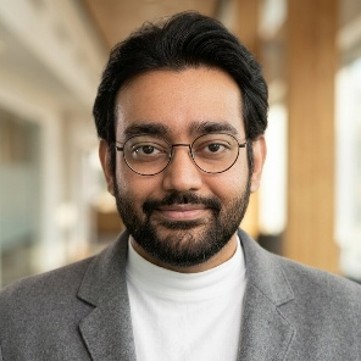
Dr. Sachin Vaidya is currently a postdoctoral associate in Prof. Marin Soljačić’s group at the Massachusetts Institute of Technology. He is also a junior investigator at the NSF AI Institute for Artificial Intelligence and Fundamental Interactions. His research focuses on studying emergent properties in topological quantum and photonic matter, and on developing interpretable AI and robotics methods for accelerating their discovery. He earned his PhD in Physics from the Pennsylvania State University in 2023, working with Prof. Mikael Rechtsman, where he worked on realizing topological phenomena in photonic crystals.