
COLLOQUIUM 2026
Programming DNA Matter Inspired from Life and Interfacing with Life
| Speaker | Professor Andreas Walther, Life-Like Materials and Systems, Department of Chemistry, University of Mainz, and Max Planck Fellow @ MPI for Polymer Research, Mainz, Germany |
| Date/Time | Wednesday, 28 Jan, 3pm |
| Location | LT27 |
| Host | A/Prof Wang Zhisong |
Abstract
Artificial cells provide a powerful route toward understanding and engineering life-like behavior in fully synthetic matter. In our work, we develop DNA-based artificial cells as programmable, non-equilibrium compartments that go far beyond passive encapsulation. By exploiting sequence-encoded phase behavior and dense DNA condensation, these systems exhibit rich internal physics, including non-Fickian transport, viscoelastic confinement, and the emergence of functional architectures such as artificial cytoskeletons and nucleus-like domains. When coupled to DNA reaction networks and strand-displacement circuits, artificial cells can sense chemical cues, process information, and generate adaptive responses, enabling controlled communication and collective behavior across protocellular assemblies.
As a complementary direction, we advance mechanobiology through synthetic, DNA-based force-sensing platforms that interface directly with living cells. Programmable aptamer mechanoreceptors and nuclease-resistant DNA tension probes enable cell-specific, long-term mapping of molecular forces with temporal control. By integrating DNA mechanics with molecular circuits, these systems move beyond force readout toward conditional signal processing at the biointerface. Together, these approaches bridge artificial cells and mechanobiology, positioning DNA as a unifying materials platform to study mechanochemical feedback and adaptive behavior at the interface of synthetic and living systems.
One review: A. Samanta, L. Baranda Pellejero, M. Masukawa, A. Walther “DNA-Empowered Synthetic Cells as Minimalistic Life Forms” Nat. Rev. Chem. 8, 454, (2024).
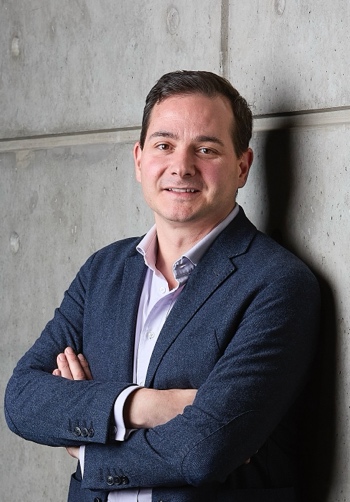
Biography
Andreas Walther is a Professor for Macromolecular Materials and Systems at the Department of Chemistry at the Johannes Gutenberg University in Mainz (Germany), as well as a Max Planck Research Fellow at the MPI for Polymer Research. His research interests focus on developing life-like materials and systems that integrate dynamic processes and principles of chemical intelligence inspired from the basic principles of life. He was appointed to his present position in Mainz in 2020 with the prestigious support of the Gutenberg Research College. Andreas Walther is the recipient of an ERC Starting Grant and of an ERC Consolidator Grant. He was a co-founder of the DFG Cluster of Excellence on “Living, Adaptive and Energy-Autonomous Materials Systems” (livMatS).