
COLLOQUIUM 2025
Mechanism and design principle of ATP synthase
| Speaker | Hiroyuki Noji, Department of Applied Chemistry, University of Tokyo, Tokyo, Japan |
| Date/Time | Wednesday, 26 Nov, 3pm |
| Location | S11-02-07 |
| Host | Prof Yan Jie |
Abstract
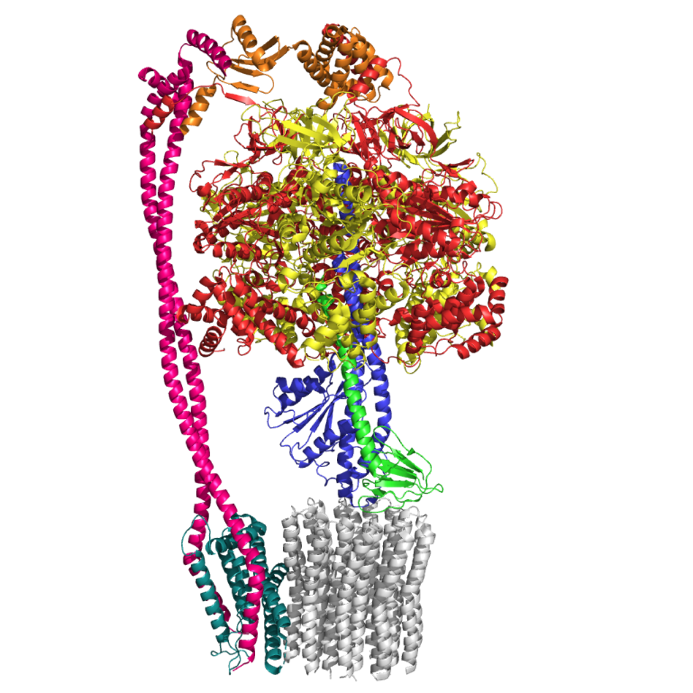
FoF1-ATP synthase is one of the most ubiquitous and essential enzymes, driving ATP synthesis through oxidative phosphorylation. It is also a representative of a molecular rotary motor, which electrochemical energy stored in the proton motive force is converted into chemical free energy via mechanical rotation of an internal rotor. Since the direct observation of the rotary motion of the F₁ catalytic domain, we have been exploring the mechanism of chemomechanical coupling in ATP synthase using single-molecule manipulation techniques and, more recently, structural analyses. These approaches have deepened our understanding of the fundamental principles governing its energy conversion mechanism.
In the first part of my talk, I will briefly summarize what we have learned about this rotary catalysis mechanism. In the later part, I will focus on fundamental questions regarding the design principles of this enzyme. For instance: why does the enzyme consistently adopt a structurally asymmetric configuration by attaching only one peripheral stalk, despite the intrinsic rotary symmetry of both F₀ and F₁? Why is symmetry mismatch between the two domains conserved across species? And what might the architecture of its ancestral form have looked like? Although these questions remain unresolved, I will present our recent findings based on protein engineering approaches, offering new perspectives on the evolutionary and functional logic that shapes this remarkable molecular machine.
Biography
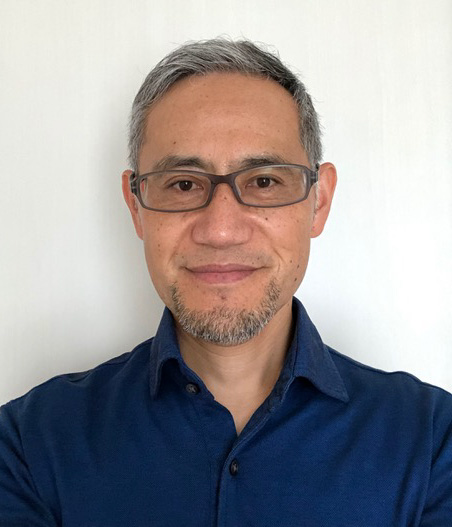
Prof Hiroyuki Noji is a pioneer in single-molecule biophysics and digital bioanalysis, with longstanding contributions to ATP synthase research and the development of ultra-sensitive enzymology platforms. Building on these foundations, his research has expanded into synthetic biology, establishing technologies for digital protein synthesis, high-throughput enzyme screening, and artificial cell engineering.
Prof Noji has extensive leadership experience in large-scale, interdisciplinary programs, including service as Program Manager of the ImPACT program “Artificial Cell Reactor Technology” (2015–2019) and Research Supervisor of the JST PRESTO program “Supra-assembly of biomolecules” (2020–2025). These roles highlight his ability to coordinate academia–industry–government collaborations, intellectual property strategy, and translational research.
With over 289 peer-reviewed papers, 15,327 citations, and an H-index of 56 (Scopus), his career reflects both high-impact basic science and translational outcomes such as the establishment of biotech startups. Prof Noji is committed to applying digital bioassay concepts to enzyme engineering and to advancing artificial cell research with global impact.