
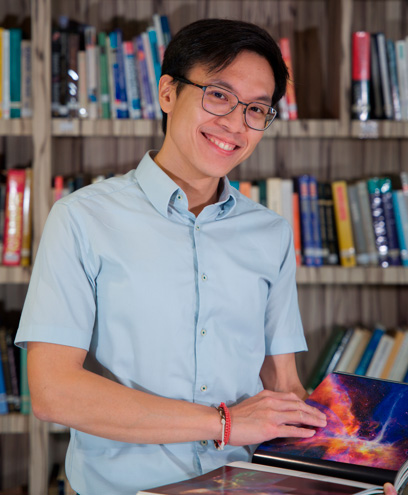
An Interview with Asst Prof Marc Hon

Asst Prof Marc Hon Teng Yen, NUS Presidential Young Professor, Department of Physics, shares his research interests and works in the field of astrophysics.
What drew you into the world of astrophysics?

Curiosity, a sense of adventure, and a lifelong impulse of wanting to study something grand and beyond our everyday experience. The cosmos, being literally out of this world, delivers on that part.

The brightness of starlight over time can reveal the fundamental properties of stars, such as their sizes, masses and even ages.
Briefly share with us your current research interests.

There is a duality to my research interests.

As an observational astronomer, I use starlight to address some of the following questions:
How do stars live and die?
What is the stellar demographic of our Milky Way and what is our place in it?
Around what kinds of stars do planets form?
What kinds of unusual star and planetary systems are out there, waiting to be discovered?

As a computational astronomer, I am driven to seek modern tools that we can wield that can help us address this science, namely looking at data-driven algorithms and machine learning.

How does artificial intelligence help astrophysicists like yourself make sense of the huge astronomical data gathered?

We are indeed ingesting data at unprecedented rates, though it isn’t simply about volume, but the added complexity of the data. This comes naturally when we have better telescopes and so we can now not only capture the Universe in increasingly fine detail, but also at much grander scales. To do science at both ends of this spectrum, we need clever approaches to triage, characterise, and discover patterns. The methods underlying artificial intelligence provide the metaphorical toolbox for astronomers vital to continue our vast exploration of the Universe in light of these modern-day challenges.

As an assistant professor under the NUS Presidential Young Professorship, what role do you see yourself playing at NUS Physics?

I’m hoping to expand the scope of astronomy research in NUS Physics, hopefully develop NUS (and Singapore) as a powerhouse for stars and planet research, keeping abreast of leading advancements in the field from global space agencies like NASA and the European Space Agency.

What kinds of discoveries do scientists hope to make with data from missions such as the NASA’s Kepler or the James Webb Space Telescope?

The beauty about astronomy and astrophysics is that there is still so much out there left to discover. Depending on which scientist you ask that’s working on the data from these missions, what is at the top of their discovery wish list could vary from searching for habitable exoplanets and extraterrestrial life, revealing the nature of dark matter, understanding black holes, or studying the origin and evolution of galaxies (including our Milky Way), among others!

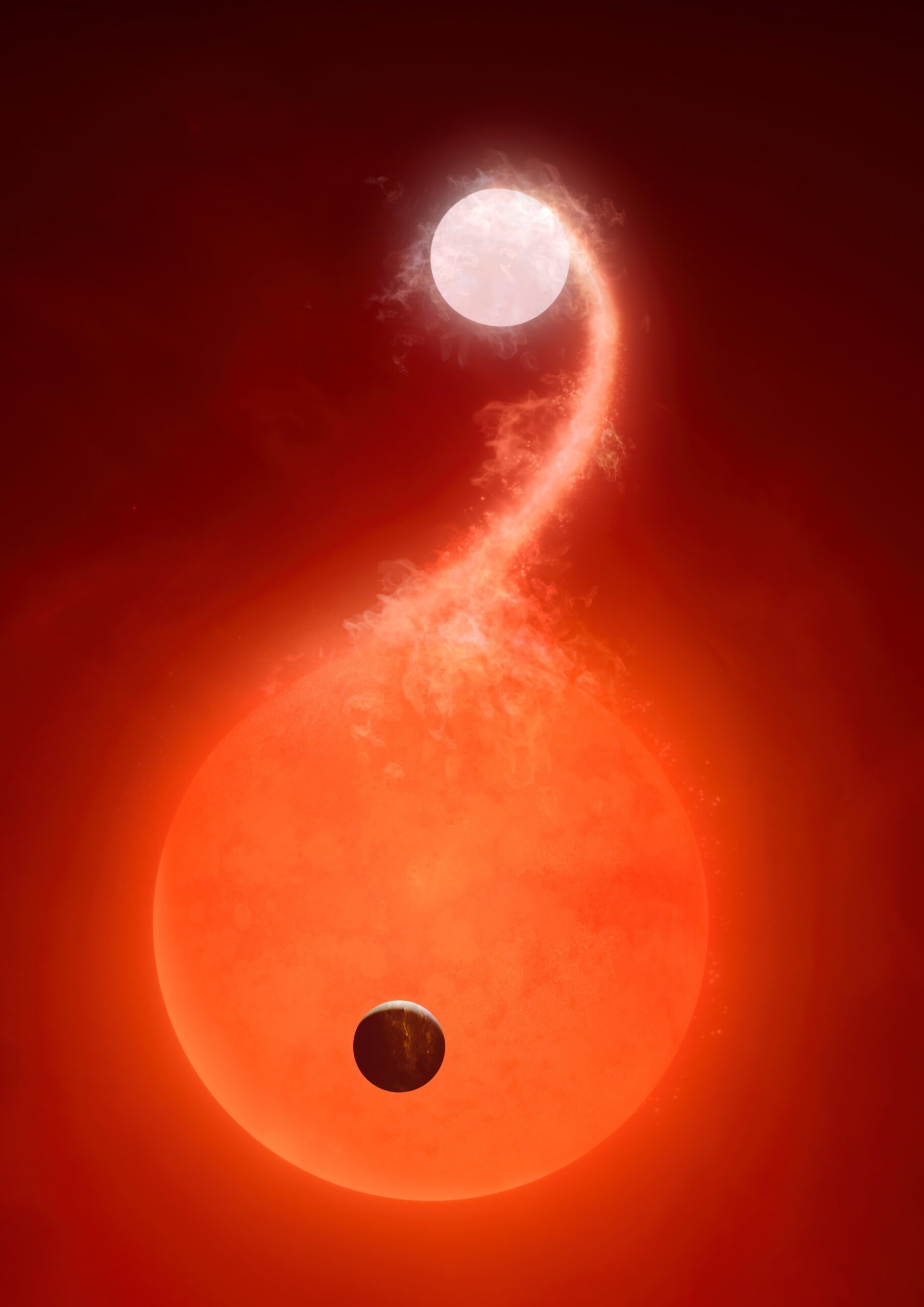
Artist’s illustration of a planet orbiting a red giant-white dwarf binary, an exotic planetary system that may describe the survival of the planet Halla, as discovered in 2023 (Hon M et al., “A close-in giant planet escapes engulfment by its star”, Nature, 618, 7967, 917–920 (2023); DOI: 10.1038/s41586-023-06029-0).

What advice would you give young students who are fascinated by space but do not know where to start?

At the top level, do check out outreach resources from leading space agencies and observatories—these frequently do a fantastic job of vividly portraying our most exciting and recent discoveries.

Astronomy is a field that prides itself in its openness of data. Not only is most of collected space data publicly available, but there have been increasing efforts over the past decade in making them more accessible, such as through hands-on tutorials and the open sharing of analysis codes. This has greatly lowered the barrier of access into the field, and I encourage those with a growing interest to take advantage of this openness. There are also citizen science programmes around the world, which are always welcoming towards anyone willing to lend their time.

When you’re not gazing at the stars (or data from them), what do you enjoy doing in your free time?

Many of the things that terrestrial inhabitants do, such as watching movies, baking, and enjoying nature through hiking!

Artist’s illustration of BD+ 05 4868 Ab, a disintegrating planet with a comet-like tail discovered in 2025 (Hon M, et al., “A disintegrating rocky planet with prominent comet-like tails around a bright star”, The Astrophysical Journal, 984, 1, Art. No. L3, IOP (2025); DOI: 10.3847/2041-8213/adbf21).