
Seminar 2026
Scrooge Ensembles: A Universal Framework for Quantum Many-Body Systems
| Speaker | Mr Dariel Mok, California Institute of Technology, USA |
| Date/Time | Tuesday, 1 Dec, 11am |
| Location | S11-02-07 Conference room |
| Host | Asst/Prof Ho Wen Wei |
Abstract
Despite their exponential complexity, quantum many-body systems exhibit remarkable universal behavior. While conventional statistical ensembles successfully describe the thermalization of local observables, they do not fully capture nonlinear and global properties of quantum pure states, such as entanglement, magic, and higher-order measurement statistics. In this talk, I will present a unified statistical framework based on Scrooge ensembles, which naturally generalize Haar-random ensembles to incorporate physical constraints.
I will first discuss the emergence of Scrooge ensembles through many-body dynamics and partial measurements, establishing rigorous results that underpin the phenomenon of deep thermalization. We identify three essential physical ingredients underlying this emergent universality: magic, scrambling, and coherence, and demonstrate the emergence of Scrooge ensembles across diverse physical settings, including quantum circuits and integrable ground states. I will then show how this framework can be extended to describe global properties of equilibrium pure states, uncovering universal thermodynamic behavior of quantum magic and revealing the robustness of extensive long-range magic at high temperatures. Finally, I will discuss how these insights can be leveraged to develop practical protocols for benchmarking quantum simulators.
Biography
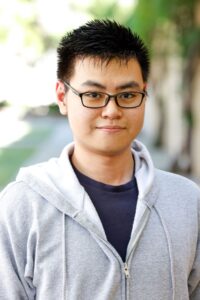
Dariel Mok is a PhD candidate in Physics at the California Institute of Technology, working with Prof John Preskill. His research lies at the intersection of quantum information science, quantum many-body physics, and atomic, molecular, and optical (AMO) physics. He investigates universal phenomena that emerge in complex quantum systems, including collective quantum behavior, many-body dynamics, and nonlinear phenomena. His theoretical research also explores how these insights can be harnessed for quantum technologies, with applications in precision metrology, quantum control, and secure communication.