My academic journey at NUS
Chai Xingni [PhD 2026]
If I were to summarise my PhD journey, it felt like trying to build a final product with an ever-changing blueprint and no instructions. I completed my undergraduate studies in physics with a minor in medical physics before embarking on research into colour centres in wide-bandgap semiconductor materials.
I am extremely thankful to my supervisor, Associate Professor Andrew Bettiol, for entrusting me with my PhD project and trusting me to keep the valuable samples safe and free from harm—other than the damage intentionally inflicted by the ion beam. I also recall stepping into a new research field with no prior experience. With the gracious guidance of Dr Yang Chengyuan and Dr Liang Haidong, I learned the ropes, and they have been an invaluable presence throughout my research journey.
Throughout these four years, I have had opportunities to collaborate with fellow researchers and attend an international conference, the International Conference on Nuclear Microprobe Technology and Applications 2024, in Madrid, Spain. These experiences pushed me out of my comfort zone, tested the limits of my introversion, and opened my eyes to the latest developments in the field through interactions with peers and experts.
I also experienced the joy of teaching as a teaching assistant for senior lecturer Dr Chan Taw Kuei for the course HSI2014 Science, Medical Technology and Society. Even during my undergraduate years, I thoroughly enjoyed learning about medical physics from Dr Chan. I am grateful for the privilege of working alongside someone so dedicated to improving the learning experience of students.
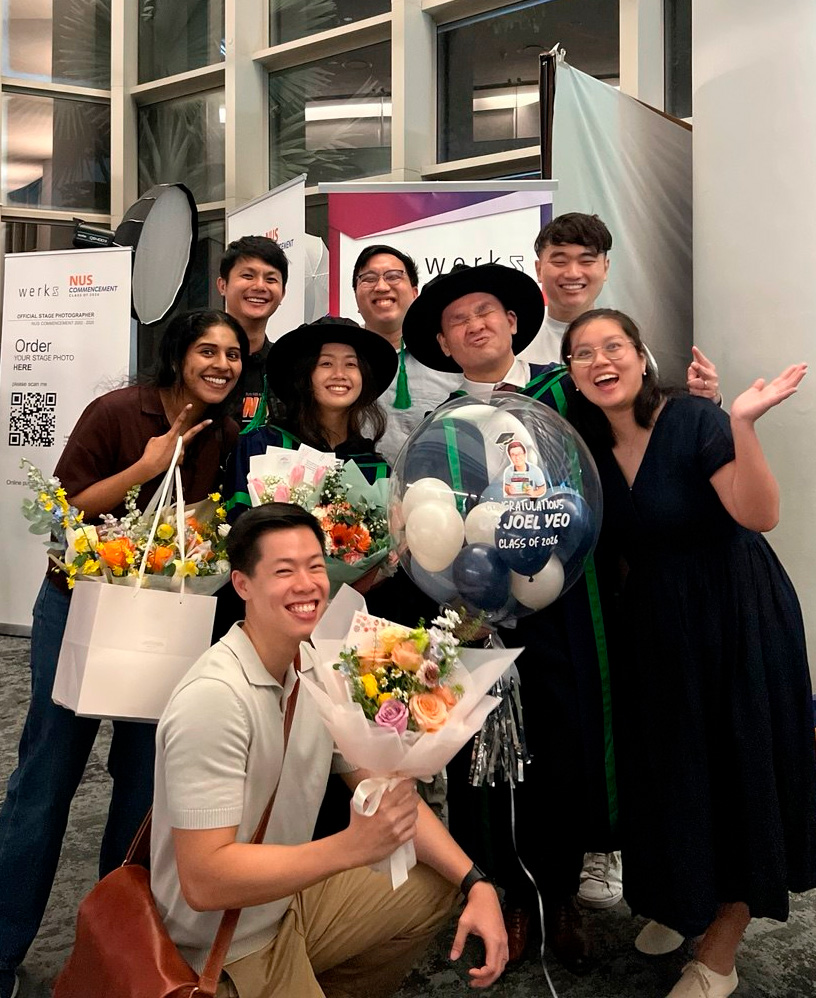
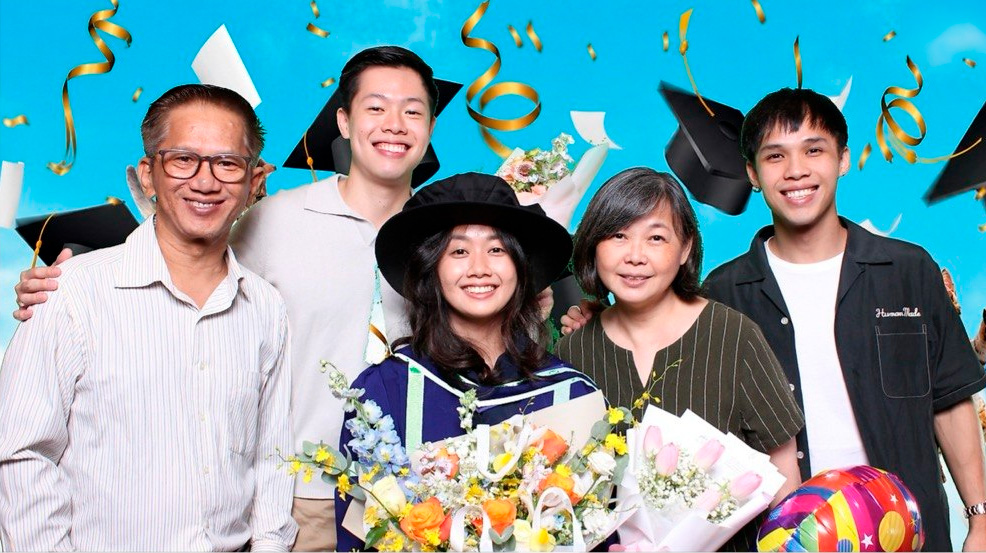
When I think back on these four years, what I remember most fondly is not the weeks spent analysing spectral data and photoluminescence maps, but the friends and family who supported me every step of the way. During the inevitable moments of despair brought on by failed experiments, I found comfort in lamenting with my friends in the master’s and PhD programmes over countless cups of coffee. We spent weeks and months studying for our qualifying examinations together, worked through assignments together, and celebrated successful experimental results together. Faced with new obstacles at every turn, I am fully convinced that I would not have made it through without the help of the people God has placed in my life.
I would also like to thank Ms Lau Siew Keok for her administrative expertise and unwavering support. Thank you for helping me secure my courses and for overseeing countless administrative matters from matriculation to graduation. You are a gem.
Maybe the real PhD was the friends we made along the way (and possibly a very bad caffeine addiction). And I have indeed made cherished friends throughout this journey.
When I think back on these four years, what I remember most fondly is not the weeks spent analysing spectral data and photoluminescence maps, but the friends and family who supported me every step of the way.
Chai Xingni