SEMINAR 2026
Chirality in Condensed Matter: From Quantized Nonlinear Hall Effect to Direct Mechanical Torque Probe of Crystal Chirality
| Speaker | Mr Peshcherenko Nikolai, Max Planck Institute for Chemical Physics of Solids, Dresden, Germany |
| Date/Time | Tuesday, 31 Mar, 2pm |
| Location | S11-02-07 Conference Room |
| Host | Asst/Prof Zhang Yang |
Abstract
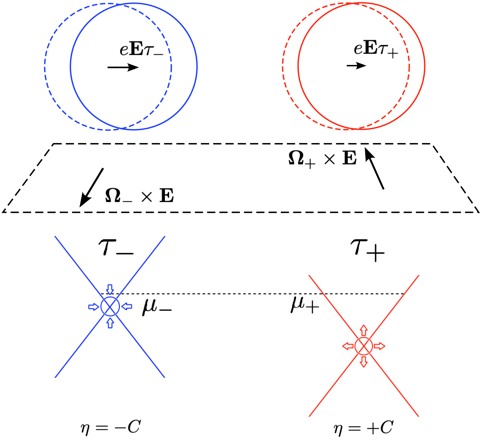
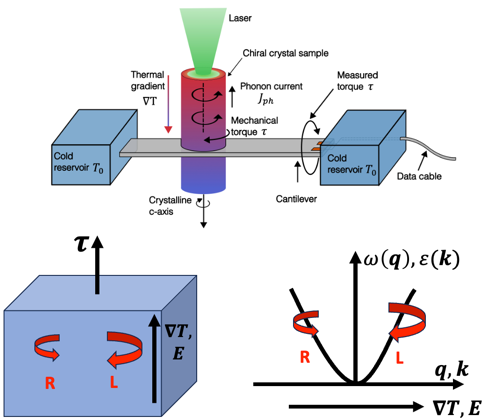
Chirality in condensed matter physics governs a wide range of electronic and structural phenomena, yet its direct detection and quantitative characterization remain challenging. In this talk, I present two approaches that connect chiral microscopic physics to macroscopic observables. I first discuss the nonlinear Hall effect in time reversal symmetric systems, with a focus on chiral Weyl semimetals without mirror symmetry. In these systems, an energy offset between Weyl nodes induces chirally asymmetric intranode relaxation, leading to a quantized nonlinear Hall response that serves as a robust transport feature of electronic chirality. I further introduce the ‘Chiralometer’, a mechanical probe of crystal chirality based on non-equilibrium angular momentum generation. Driving electrons or phonons out of equilibrium produces an angular momentum imbalance that manifests as a measurable macroscopic torque, with the phonon contribution already measured in an experiment on chiral Te. First-principles and semiclassical analyses further show that the electronic contribution is also within current experimental sensitivity. Together, these results establish both nonlinear transport and mechanical response as powerful probes of chirality in quantum materials.
References:
- N. Peshcherenko et al, Physical Review B 10 (15), 155143 (2024)
- N. Peshcherenko et al, arXiv:2602.09556
- H. Zhang, N. Peshcherenko et al, Nature Physics, 21 (9), 1387 (2025)
Biography
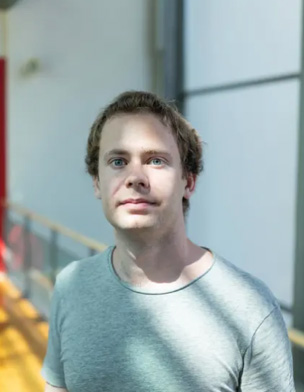
Nikolai Peshcherenko is a graduate student at Max Planck Institute for Chemical Physics of Solids at Dresden, Germany. He received his B.S. and M.S. degrees from Moscow Institute for Physics and Technology. His research interests include topological transport, physics of chirality and non-reciprocal phenomena in solids.