SEMINAR 2026
Topological Magnetic Textures for Spintronics
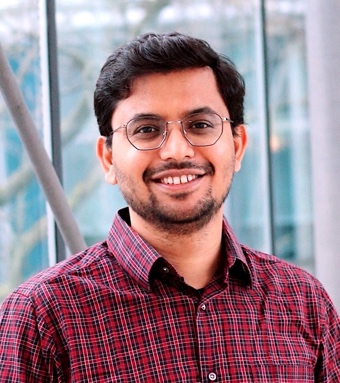
| Speaker | Dr Rana Saha, Indian Institute of Science Education and Research (IISER), India |
| Date/Time | Wednesday, 18 Mar, 2pm |
| Location | S11-02-07 Conference Room |
| Host | A/Prof Ramanathan Mahendiran |
Abstract
A central frontier in spintronics is the exploration of magnetic materials with non-collinear spin arrangements that give rise to complex topological textures such as skyrmions [1]. These nanoscale, particle-like magnetic objects, characterized by chiral spin configurations and topological protection, have emerged as promising candidates for robust and energy-efficient information carriers. The realization of skyrmion-based technologies relies on the discovery and rational design of quantum materials that host chiral magnetic interactions and tunable magnetic anisotropy. In this seminar, I will present recent advances in quantum materials that stabilize topological magnetic textures, with emphasis on underlying design principles and state-of-the-art experimental characterization. In particular, I will highlight in-situ Lorentz transmission electron microscopy as a powerful technique for directly imaging and controlling skyrmions under applied magnetic field and temperature. Case studies will focus on tetragonal Heusler compounds [2-4] and emerging two-dimensional magnetic systems [5-6] that host skyrmions and antiskyrmions. These studies demonstrate the promise of topological magnetic nanostructures for future spintronic memory.
References:
- Nagaosa, N. et al., Topological properties and dynamics of magnetic skyrmions. Nat. Nanotechnol. 8, 899 (2013).
- Jena, J., et al., Elliptical Bloch skyrmion chiral twins in an antiskyrmion system. Nat. Commun. 11, 1115 (2020).
- Ma, T., et al., Tunable magnetic antiskyrmion size and helical period from nanometers to micrometers in a D2d Heusler compound. Adv. Mater. 32, 2002043 (2020).
- Saha, R., et al., Intrinsic stability of magnetic anti-skyrmions in the tetragonal inverse Heusler compound Mn1.4Pt0.9Pd0.1Sn. Nat. Commun. 10, 5305 (2019).
- Saha, R., et al., Observation of Néel-type skyrmions in acentric self-intercalated Cr1+δTe2 Nat. Commun. 13, 3965 (2022).
- Saha, R., Meyerheim, H. L., Göbel, B., Mertig, I. & Parkin, S. S. P. Chiral magnetism and skyrmions in quantum materials. npj Spintronics 2, 21 (2024).
Biography
Dr. Rana Saha obtained his B.Sc. from the University of Calcutta. He was then offered an integrated PhD fellowship at JNCASR, Bangalore, where he obtained an M.S. degree in Materials Science with best thesis award. He continued his doctoral research on structure-property correlations of transition metal oxides exhibiting novel magnetic and magnetoelectric properties at JNCASR under the supervisions of Prof. C.N.R. Rao and Prof. A. Sundaresan and received a PhD degree in Materials Science.
He then moved to the group of Prof. Stuart Parkin as a post-doctoral research fellow at Max-Planck-Institute of Microstructure Physics in Halle, Germany. Currently he is an assistant professor in the department of Chemistry at IISER Tirupati since 2024. His research area spans over quantum materials and materials science which includes magnetoelectrics, spintronics, 2D magnetic materials, and in-situ transmission electron microscopy to develop microscopic understanding of emerging magnetic quantum materials. One of his major area focuses on in situ nucleation, manipulation and detection of chiral magnetic nanostructures, for applications in spintronic memory.