My academic journey at NUS
Tan Chuan Jie [PhD 2025]
Since my secondary school days, Physics and Mathematics have been my two favourite subjects. I was always fascinated by how physics problems could be solved using mathematical approach. Before my university course started, I was deliberating between these two disciplines. I attended the engagement activities on campus and was attracted to the laboratories and experimental setups offered by the Department of Physics. I remember how Prof Sow Chorng Haur (former head of department) showed us around the various laboratories during a tour. This convinced me to pursue Physics as my primary major and Mathematics my minor.
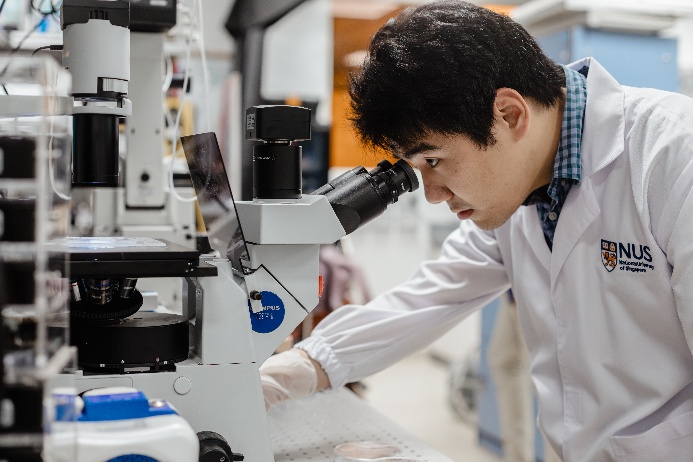
When I had the opportunity to further my studies in the Department of Physics, I accepted it without much hesitation, primarily due to my interest in experimental physics. It was incredible to me that I was conducting research in the very laboratory that had fascinated me during that tour—the Centre for Ion Beam Applications (CIBA), a large laboratory located at a discreet underground corner in the S7 building. My project was related to the field of biological physics, and I was keenly interested to learn how ion beam technology has contributed to advancements in this field.
Under the old undergraduate curriculum, we were required to study four physics and two mathematics modules in the first year. It was not easy, especially after two years of national service for the male students. We had to learn new concepts on top of recalling what we had learned before. We also had to compete with the mathematics majors for the same mathematics modules. However, I was glad to make friends with several course mates, and we studied together frequently, helping one another to revise and understand the difficult concepts.
My academic journey has taught me to think outside of the box. I also have learned to be more resilient, finding (sometimes unconventional) solutions when things do not go as planned.
Tan Chuan Jie
This continued throughout my undergraduate days. Before major exams, we would book the study rooms above the Frontier canteen and study together the entire day and for the whole week. We also wrote out and explained complex solutions on the whiteboards in the old Science Library at S6 Level 4. Through these sessions, I learned that a single stick breaks easily but, bundle together, sticks become strong and unbreakable. Like bundled sticks, we helped and encouraged one other when times became tough. It is very tough for a student to get by alone. Friends are truly important.
Though such study sessions became impractical during my PhD study, I had good colleagues and friends in my research groups who willingly and frequently helped me whenever I needed it. My two thesis advisors, A/Profs Jeroen van Kan and Johan R C van der Maarel, were also readily available when I was seeking direction and advice. Outside of the lab, my church friends prayed for me, which helped ease my anxiety as well.
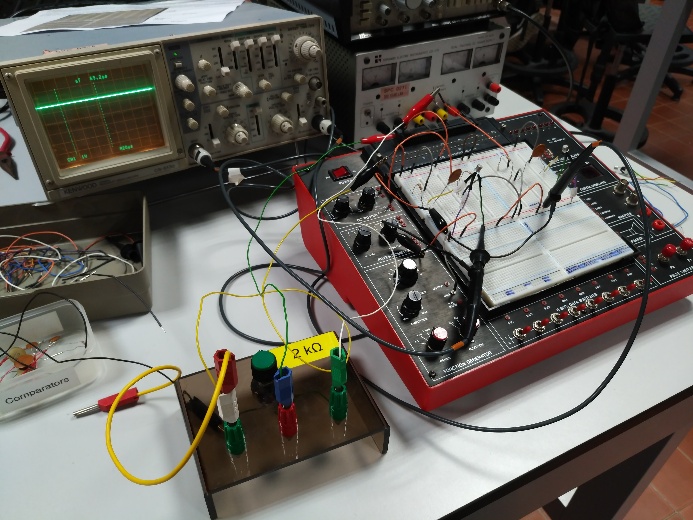
I vividly remember how I developed my passion for experimental physics while taking two compulsory experimental modules. I enjoyed these modules so much that I would return to the lab outside of my scheduled sessions to conduct experiments using the various setups. They provided a welcome relief amidst other demanding modules, allowing me to engage in hands-on experiments and data collection as a refreshing break from the intensive theoretical lectures and tutorials.
I was overjoyed when I was assigned to be one of the laboratory demonstrators for an experimental module during my graduate studies. I still recall the many conversations I had with Mr Dicky Seah (the laboratory technologist whom many in the department are familiar with), sparked by our shared interest in cars and various technical subjects. Some of these conversations even inspired me to explore new hobbies outside my research.
Besides the enjoyable time in the modules, the knowledge I have gained from them enhanced my teaching experience in an engineering science core module that also involved experiments and data collection. As a physics Graduate Teaching Assistant in an engineering module, I was able to share insights from an experimental physics perspective with the students.
My physics education in NUS was totally different from what I had expected before enrolling in the university. It required hard work and determination to keep up with the curriculum. However, this was made easier with friends who offered support along the way and we encouraging one another and providing the motivation necessary to complete the course.
My academic journey has taught me to think outside of the box. I also have learned to be more resilient, finding (sometimes unconventional) solutions when things do not go as planned. Often in life, we tend to overcomplicate matters and overlook simpler solutions. One example of this was how Dr Kenneth Hong (who taught us many undergraduate modules back then) could solve questions within minutes simply by typing it out on his computer, while most of the rest of us struggled, writing several pages of solutions but still failing to reach the answer.
At present, I am taking a break after researching almost non-stop since August 2020, when I began my PhD programme. Now, with much more free time, I am rediscovering my hobbies after several years of putting them on hold.