
My academic journey at NUS
Yeo Zhen Yuan [PhD 2025]
My PhD journey at NUS was a winding hike, full of unexpected turns, lucky breaks, and invaluable support from peers and mentors in the Faculty of Science. The real reward wasn’t a single paper or project but realising that research is a never-ending adventure, pushing me to live curious and embrace the unknown.
Perhaps the most profound lesson came from developing resilience through intellectual humility. During my qualifying exam, I faced a fundamental question that I couldn’t answer. Instead of bluffing my way, I admitted, “I don’t know,” and worked through it aloud. The examiner’s response—“Now you’re thinking like a scientist”—stuck with me. This mindset transformed setbacks into opportunities.
Yeo Zhen Yuan
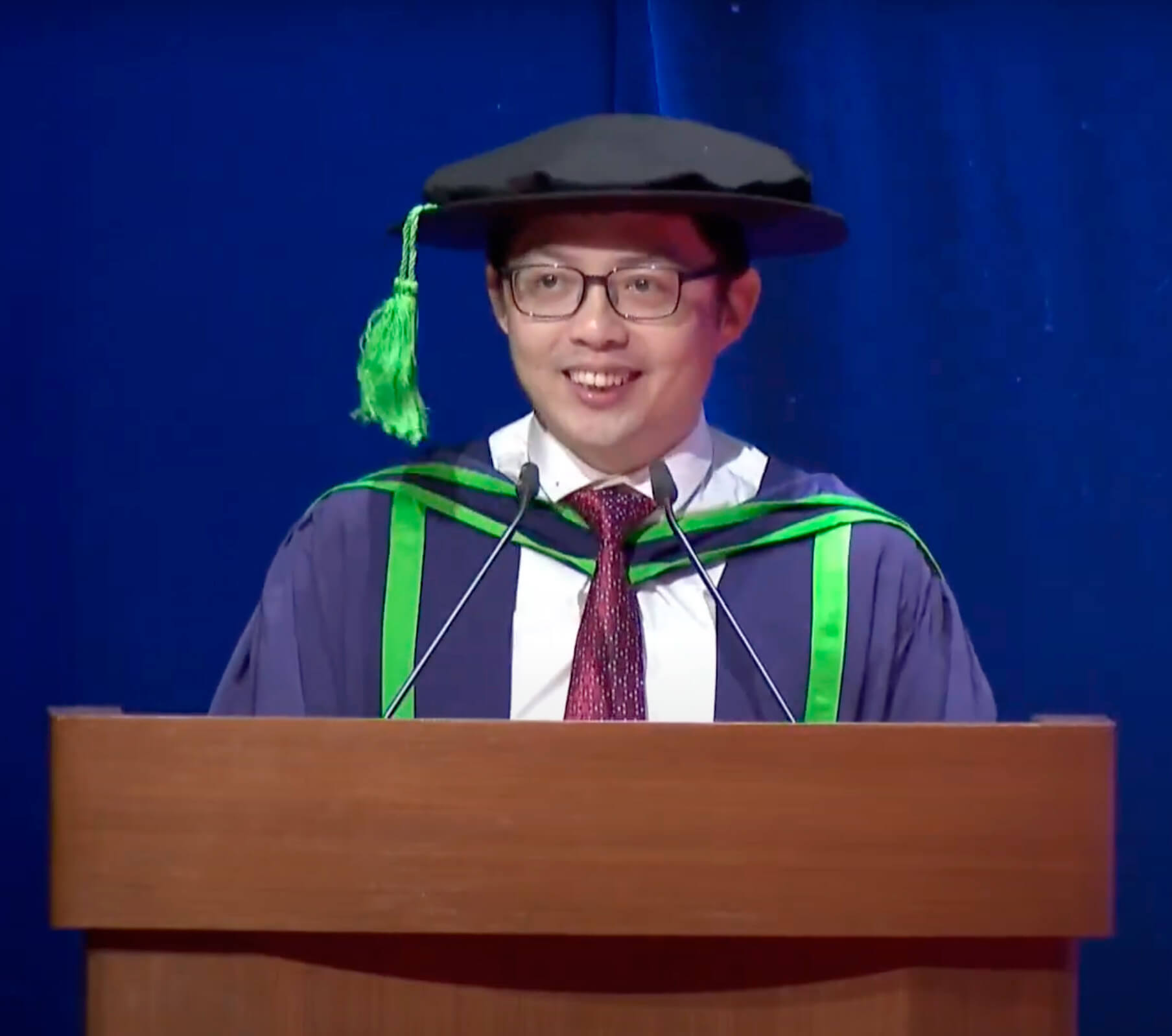
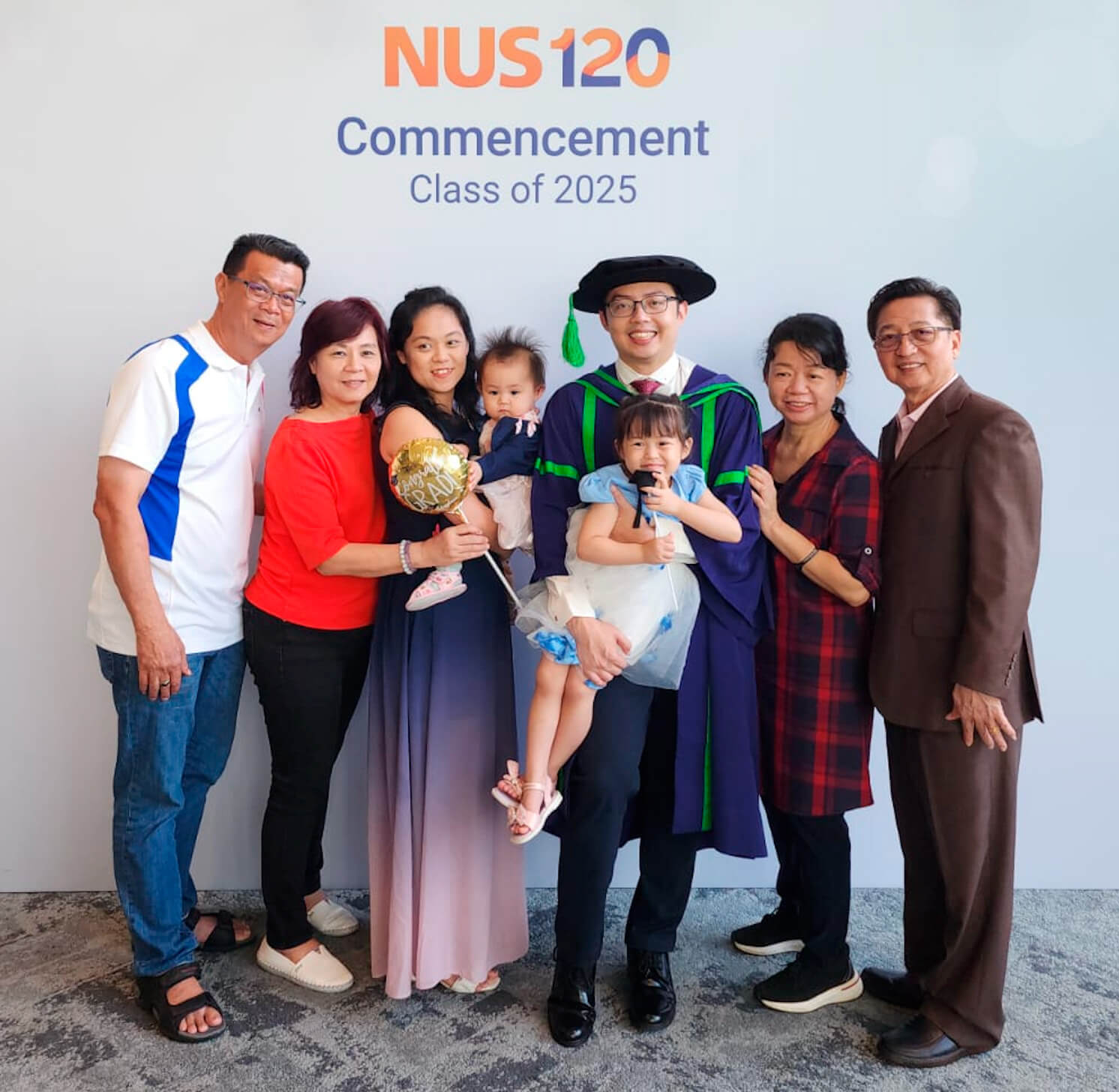
One of the most transformative experiences was discovering the power of cross-disciplinary collaboration. While being attached to the Environmental Health Institute, I worked on the evolution and global dispersal of a new Dengue virus type 2 genotype. Drawing on my physics training from the NUS Special Programme in Science, I applied first-principles thinking to their phylogenetic data, creating a visualisation that illustrated the virus’ heterogeneity. This contribution, published in a 2021 paper titled “Evolution, heterogeneity and global dispersal of cosmopolitan genotype of Dengue virus type 2”, showed me that physics can offer fresh perspectives to biological challenges. Collaborating across fields taught me that the most exciting science happens when diverse disciplines converge, a lesson I’ll carry forward.
Another defining moment was developing computational tools to make the invisible visible. Working with the Centre for Advanced 2D Materials (CA2DM), I devised unsupervised machine learning algorithms to analyse STEM-EELS spectra, enabling automated identification of chemical phases in complex materials. This culminated in another paper titled “Data-driven analysis of STEM-EELS spectra for high-resolution compositional mapping” published in 2025. The project’s impact went beyond technical success. It democratised advanced analysis, allowing researchers without deep spectroscopy expertise to gain insights from large datasets. This taught me that the best tools amplify human understanding, making science more accessible and impactful.
Perhaps the most profound lesson came from developing resilience through intellectual humility. During my qualifying exam, I faced a fundamental question that I couldn’t answer. Instead of bluffing my way, I admitted, “I don’t know,” and worked through it aloud. The examiner’s response—“Now you’re thinking like a scientist”—stuck with me. This mindset transformed setbacks into opportunities. Hypothesis failures and experimental dead-ends became data, each question sparked better ones, and every “I don’t know” opened new paths. This intellectual honesty shaped me into a scientist who values persistence and curiosity over perfection.
My work at NUS, from devising statistical models for carbon allotropes to pioneering an Expectation-Maximisation and Compression algorithm for electron microscopy, published in Advanced Materials and Nature, was enriched by these experiences. As I join the Department of Statistics and Data Science in NUS as a Research Fellow, I’m excited to leverage machine learning to explore nanoparticle binding events, carrying forward the interdisciplinary spirit and intellectual courage instilled by the Faculty of Science.
With heartfelt thanks, I’m deeply grateful to the support staff at NUS Physics, especially Ms Lau Siew Keok, aka Maggie, for her unwavering support with the administration and coordination throughout my undergraduate and graduate studies. I also extend my heartfelt thanks to my supervisor, Associate Professor Duane Loh, for his guidance and invaluable advice, which shaped my journey and inspired me to push the boundaries of scientific discovery.
PS: Zhen Yuan is open to collaboration or bouncing off ideas and is contactable at yeozy@nus.edu.sg.